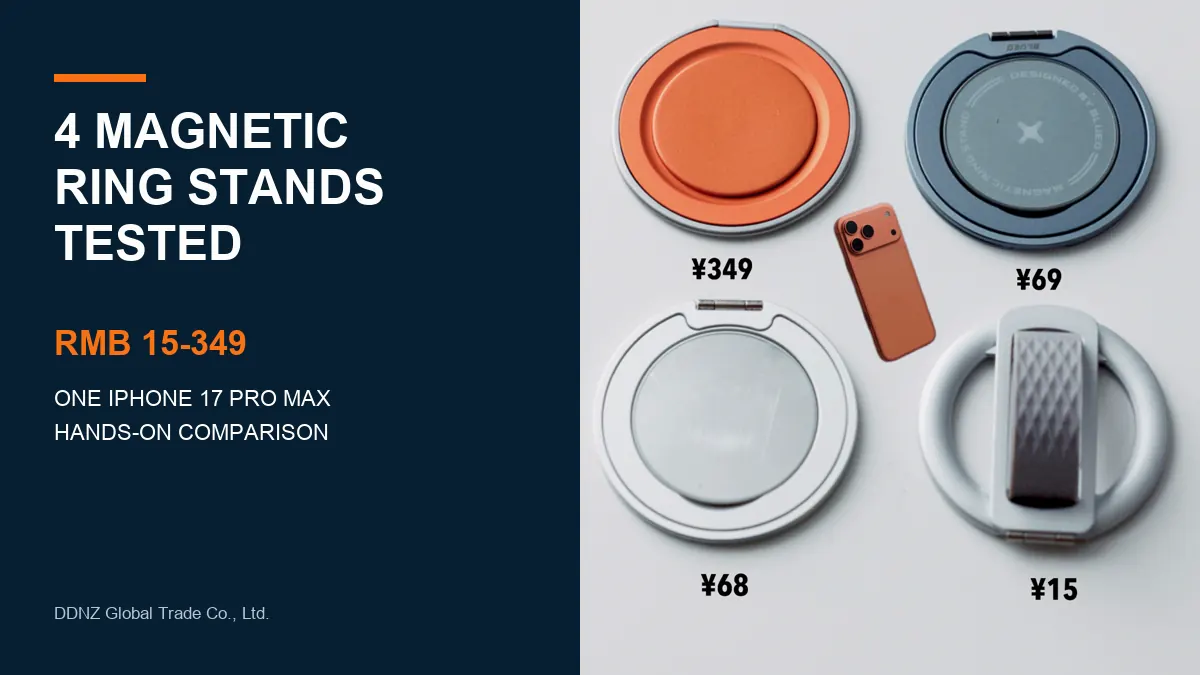
On a catalogue page, magnetic ring stands are easy to treat as a commodity. Put four of them on a phone, however, and the differences show up quickly. We bought four anonymous samples priced at RMB 15, 68, 69 and 349, then used each one on an iPhone 17 Pro Max. We weighed them, checked how firmly they held, tried them against a metal surface and a MagSafe charging setup, and used them as grips and stands. The RMB 349 sample was the best all-rounder. The more interesting commercial result was that the RMB 69 sample came surprisingly close in everyday use.
In brief
- The RMB 15 sample was also the heaviest. More material did not mean a better result.
- A stand can hold securely on a phone without attaching to metal on its outer face. Only Sample 1 did both.
- Samples 1–3 charged in our setup. Sample 4’s structure got in the way.
What we actually checked
We used one iPhone 17 Pro Max throughout and looked at the details a buyer can verify before placing an order:
- measured weight;
- relative magnetic hold;
- direct attachment to a metal surface;
- charging in the MagSafe setup shown;
- comfort as a finger grip;
- portrait and landscape stand use;
- how the phone felt in hand and whether it could lie flat.
We have kept the samples anonymous because this is a sourcing exercise, not a brand ranking. The prices are what we paid for these particular units; they are not current quotations or market benchmarks.
These were practical sample checks rather than laboratory tests. The findings apply only to the products, iPhone 17 Pro Max and setup shown here.
The four tested samples
| Sample | Price paid | Measured weight | Construction |
|---|---|---|---|
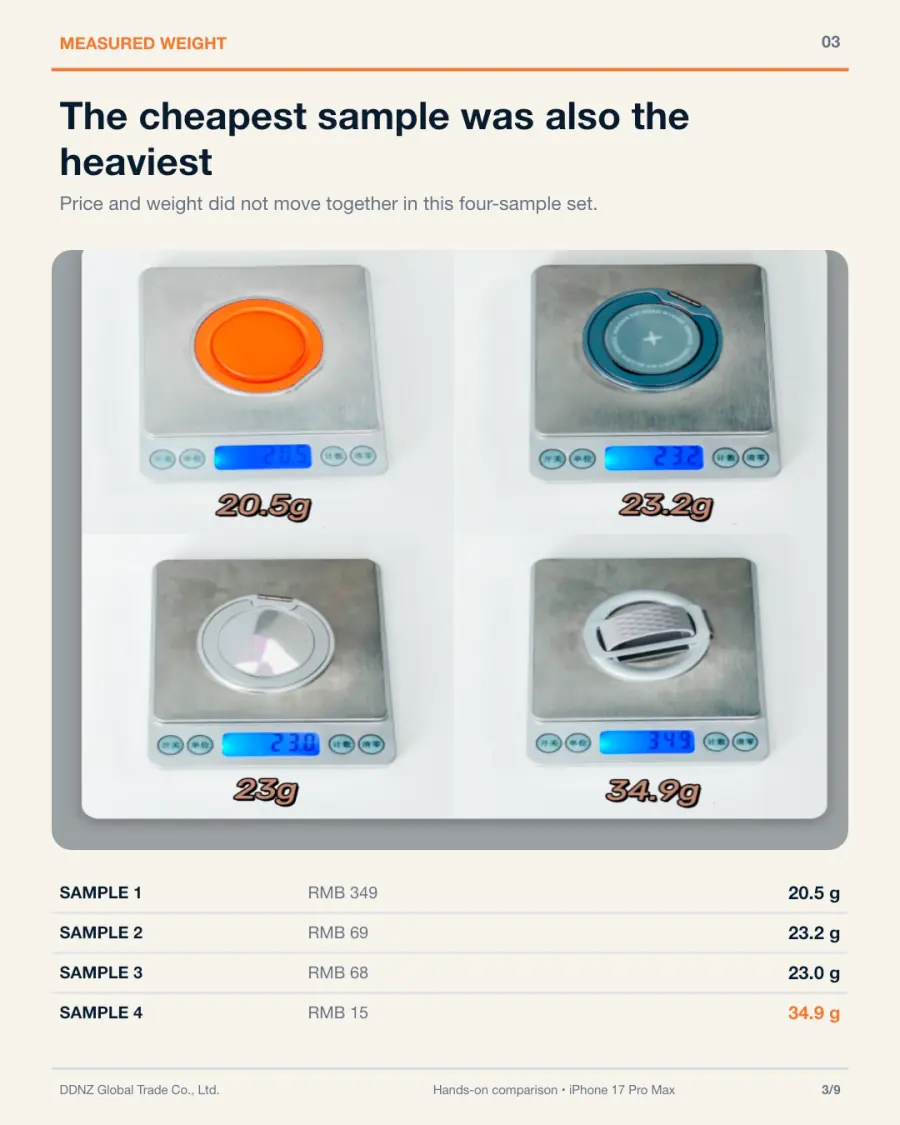
| Sample 1 | RMB 349 | 20.5 g | Rotating magnetic stand with hidden finger ring |
| Sample 2 | RMB 69 | 23.2 g | Rotating magnetic stand with hidden finger ring |
| Sample 3 | RMB 68 | 23.0 g | Rotating magnetic stand with hidden finger ring |
| Sample 4 | RMB 15 | 34.9 g | Rotating magnetic stand with soft silicone loop |
The scale gave us the first surprise: the RMB 15 sample was also the heaviest. It still had the weakest overall result of the four. Weight, magnetic performance and finish need their own lines on an RFQ; one is not a shortcut for the others.
“Strong magnet” can mean two different things
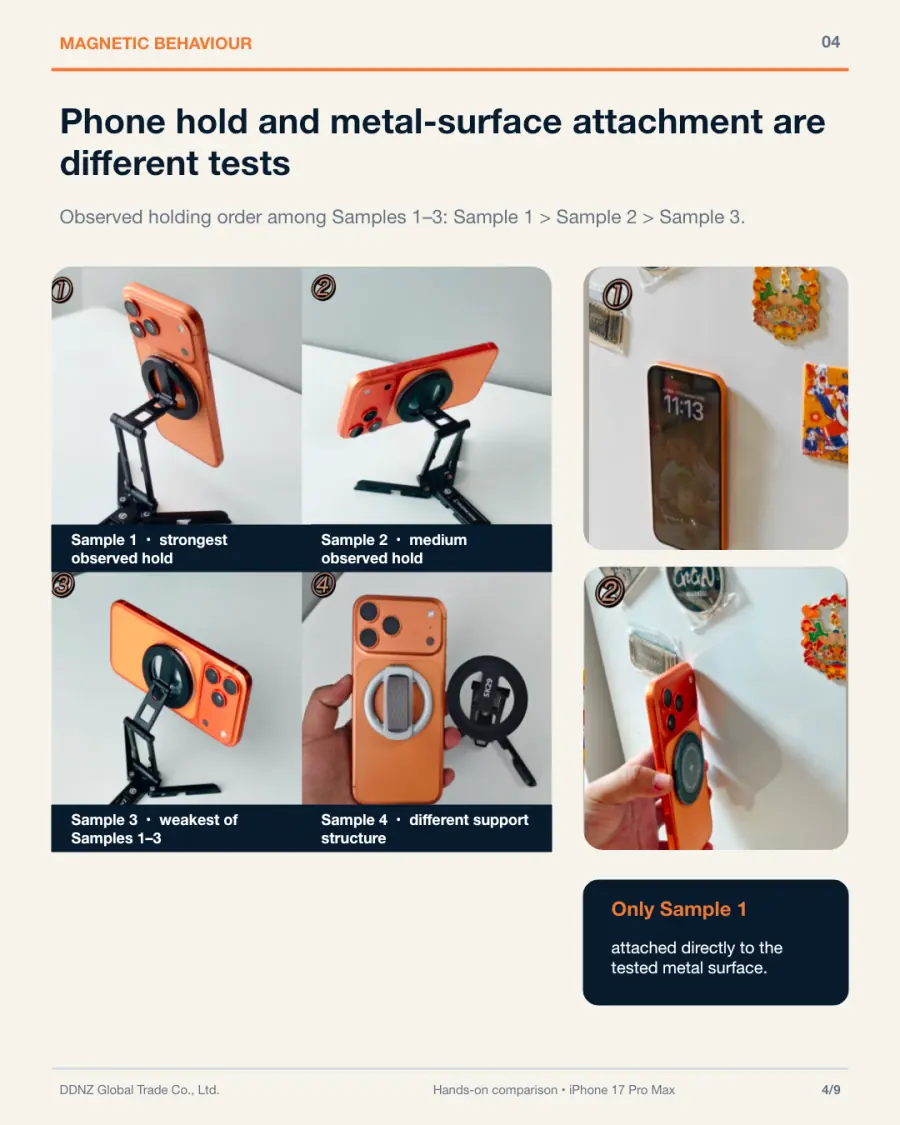
Among Samples 1–3, the holding order was clear in our hands-on check:
Sample 1 > Sample 2 > Sample 3
Sample 1 held most firmly. Sample 2 was still usable, while Sample 3 felt noticeably weaker. Sample 4 uses a different support structure, so comparing it directly with the other three would have been misleading.
Then we tried the outer face against a metal surface. Only Sample 1 held the phone there. This is an easy specification to miss: the phone-facing side may be magnetic even when the outside of the stand is not. Buyers who expect refrigerator or rack attachment need to state that requirement separately.
Instead of writing “strong magnet,” an RFQ should say:
- which side needs to be magnetic;
- whether direct metal-surface attachment is required;
- which phone, case and target surface will be used;
- what counts as a pass during sample approval.
That gives the supplier something concrete to reproduce and gives the buyer something concrete to inspect.
A MagSafe label is not enough
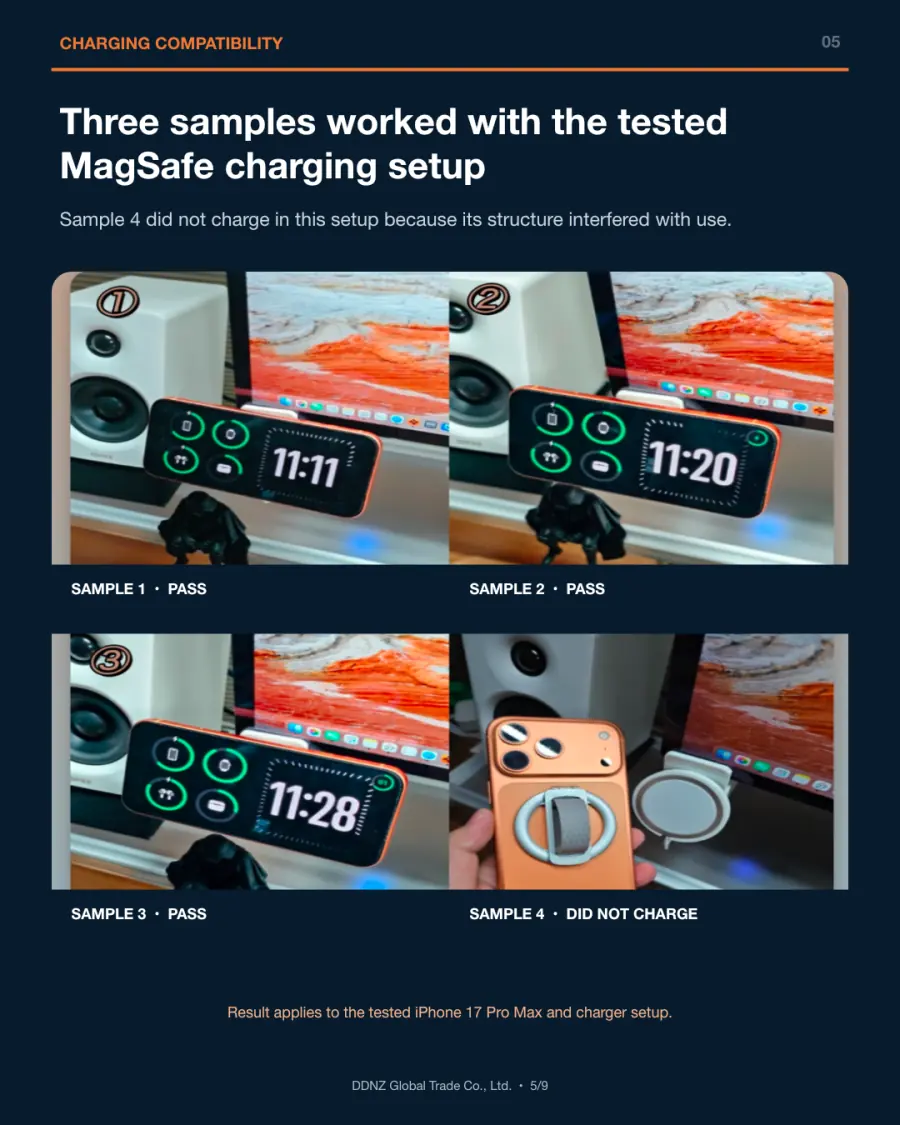
Samples 1, 2 and 3 charged in the MagSafe setup shown. Sample 4 did not because its structure interfered with the connection.
That does not make Sample 4 universally incompatible, or the other three universally compatible. Change the phone, case, charger or alignment and the result may change. The useful buying question is therefore not “Does it support MagSafe?” but “Did this approved sample charge with the configuration our customers will use?” See how DDNZ approaches MagSafe-compatible phone case verification before a dealer order.
The differences were just as obvious in the hand
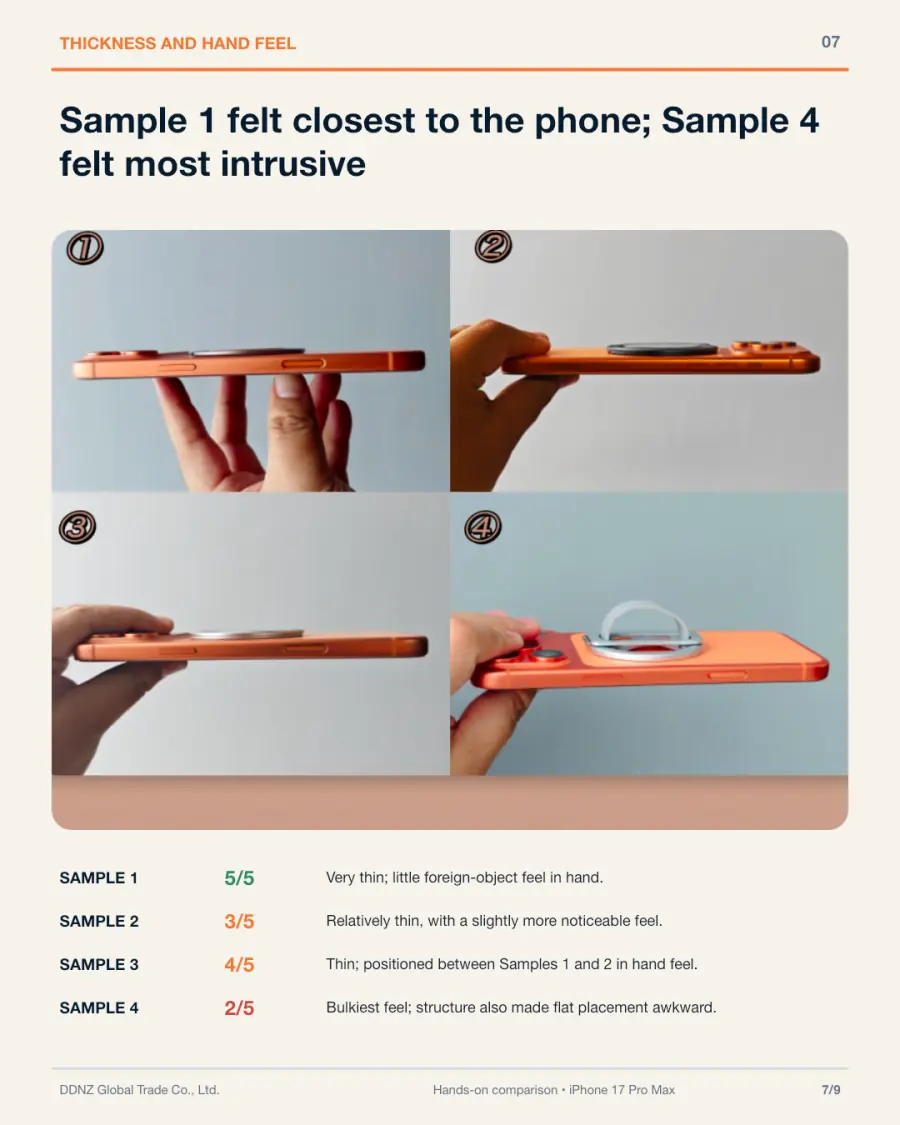
Sample 1 sat closest to the phone and gave the tightest finger support. Samples 2 and 3 opened farther and felt a little wider and looser, which some users may prefer. Sample 4’s soft silicone loop was comfortable enough, but it stayed proud of the body and made the phone awkward to place flat.
All four worked in portrait and landscape positions. That ticked the basic stand-use box, but it did not make them interchangeable. A thin everyday grip, firm finger hold, desk stand and direct metal attachment are different buying priorities. The right sample depends on which one matters most to the target customer.
Where each sample made sense
Sample 1: the strongest all-rounder
Sample 1 felt the thinnest, held most firmly, attached directly to the metal surface and charged successfully. The finish was also the most convincing. At RMB 349, though, it would need a retail position that can carry the extra cost. We did not run a long-term durability test.
Sample 2: the commercial sweet spot
Sample 2 was the easiest value case to make. It felt well finished, worked as a grip and stand, and charged in our setup for RMB 69. It did not attach directly to the metal surface, but many retail programmes will not need that feature.
Sample 3: close in price, weaker in use
Sample 3 was only RMB 1 cheaper than Sample 2. It charged and kept a fairly slim profile, but its weaker hold made the small saving difficult to justify in this group.
Sample 4: cheap, but hard to recommend as tested
Sample 4 did work as a portrait and landscape stand, and its soft loop provided a usable grip. But it was the heaviest, did not charge in our setup and would not sit neatly against the phone when closed. The RMB 15 price was attractive; the product compromises were simply too visible to ignore.
What we would lock before placing an order
| Quotation field | What to define | Evidence before production |
|---|---|---|
| SKU identity | Model, colour, construction and revision | Approved sample photos and SKU sheet |
| Weight and profile | Exact weight and closed thickness | Measured sample record |
| Magnetic design | Phone-facing magnet and any outer magnetic surface | Agreed attachment check on the stated setup |
| Charging | Target phone, case and charging setup | Recorded pass/fail result for the quoted SKU |
| Grip | Opening range, ring or loop structure and hidden/visible position | Photos plus hands-on approval |
| Stand use | Required portrait and landscape angles | Photos of the approved positions |
| Flat placement | Closed profile and whether the phone can lie flat | Side-view photo with the approved sample |
| Construction | Hinge, magnet, adhesive and surface-finish version | Supplier specification tied to the sample |
| Durability | Agreed cycle or use test, if required | Method and threshold agreed before ordering |
| Retail pack | Barcode, artwork, inserts, colour/SKU quantity and carton packing | Approved pack-out and final inspection record |
These details should sit beside the quoted SKU, not in a separate marketing deck. If the factory later changes the hinge, magnet, adhesive, finish or internal structure, the approved sample no longer tells the full story and the revised version should be checked again. DDNZ’s sample and specification approval process follows this principle.
Comparing samples from several factories?
Send DDNZ a short list rather than a folder of unrelated catalogue images. Tell us the target market, phone models, retail position, required functions, colour mix, packaging and expected first order. DDNZ Global Trade Co., Ltd. can turn that brief into a comparable supplier RFQ, coordinate sample checks and help lock the details that matter before production.
Explore sourcing support · Send a sourcing brief
Method note: DDNZ physically tested four anonymous samples on an iPhone 17 Pro Max. All results are hands-on observations limited to this four-sample set and the setups shown. No laboratory certification, safety certification, durability guarantee or universal compatibility claim is made.