If you are shipping from China to the Mediterranean or Red Sea, ask for the latest vessel schedule before you commit cargo to a sailing. Several services now have November arrangements for a return to Red Sea or Suez routing. The published dates refer to different events: a planned departure from Salalah or Tangier, or a first loading-port date in China. Some sources also disagree on the date for the same ship. Use the service names below to start a booking discussion, then confirm the exact voyage, current route and arrival estimate for your shipment.
- Check the vessel and voyage against your booking, rather than the service name alone.
- Keep first-port dates separate from the date a vessel is expected to pass through Suez.
- Compare the full quotation and delivery scope before changing your shipping plan.
Send DDNZ your loading port, destination, cargo details and ready date.
1. Five November schedule entries worth checking
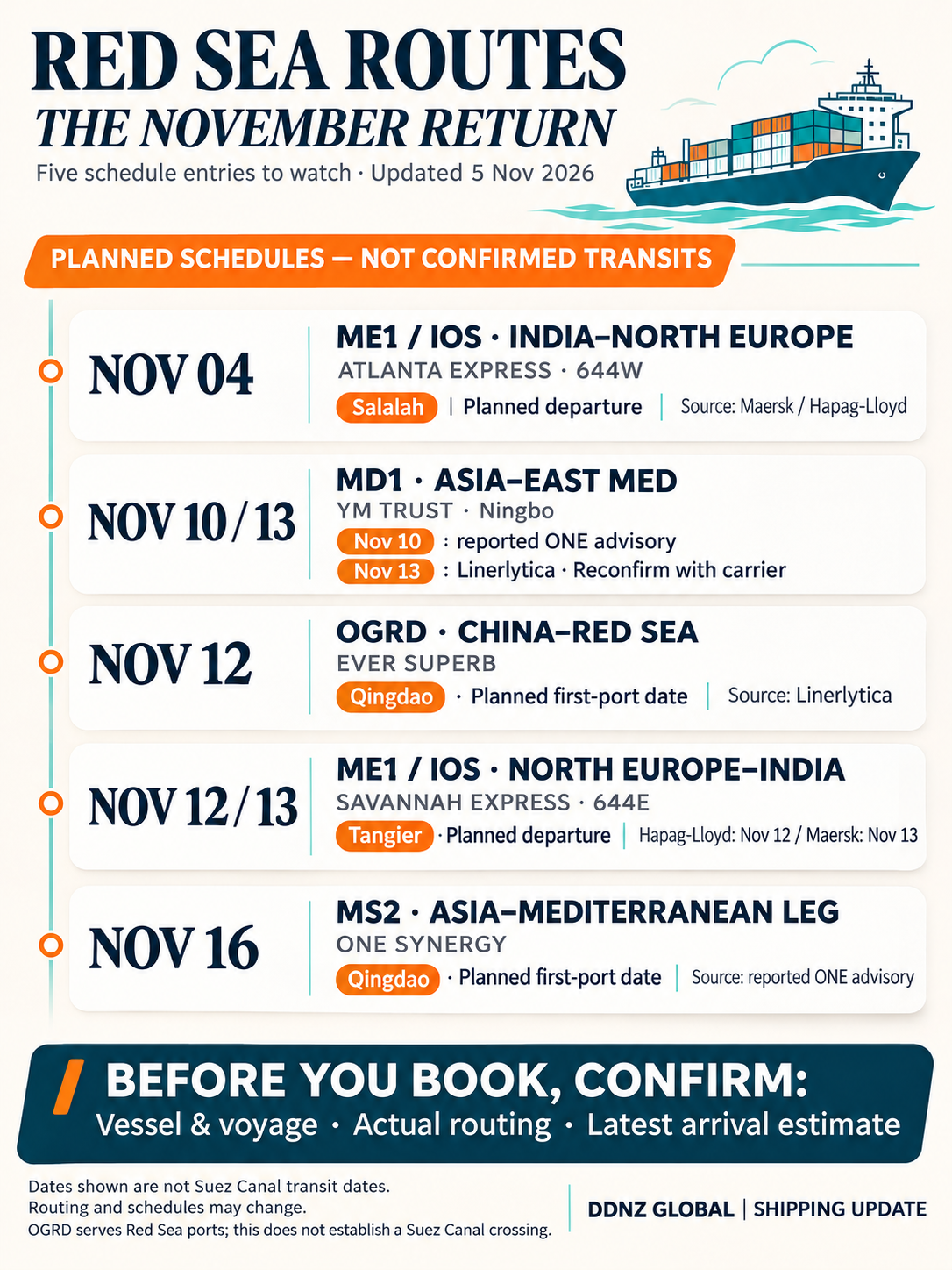
Maersk's 2 November advisory lists ATLANTA EXPRESS, voyage 644W, with a planned Salalah departure on 4 November as ME1 switches to Suez routing. For the eastbound SAVANNAH EXPRESS, voyage 644E, Maersk lists Tangier on 13 November; Hapag-Lloyd's IOS update lists 12 November. Both describe a plan subject to operating conditions. A dated advisory alone does not confirm a completed canal transit.
For China-origin cargo, reports quoting ONE's 22 October advisory identify YM TRUST at Ningbo on 10 November for MD1 and ONE SYNERGY at Qingdao on 16 November for the Asia–Mediterranean leg of MS2. Linerlytica instead lists 13 November at Ningbo for YM TRUST. We have retained that difference so it can be checked against the current booking schedule.
| Service and vessel | Published November date | Port and event | Source to check |
|---|---|---|---|
| ME1 / IOS westbound — ATLANTA EXPRESS 644W | 4 November | Salalah, planned departure | Maersk and Hapag-Lloyd |
| MD1 — YM TRUST | 10 or 13 November | Ningbo, first-port schedule entry; dates differ | Reported ONE advisory: 10 November; Linerlytica: 13 November |
| OGRD — EVER SUPERB | 12 November | Qingdao, planned first-port date | Linerlytica |
| ME1 / IOS eastbound — SAVANNAH EXPRESS 644E | 12 or 13 November | Tangier, planned departure; dates differ | Hapag-Lloyd: 12 November; Maersk: 13 November |
| MS2 — ONE SYNERGY | 16 November | Qingdao, planned first-port date | Industry reports quoting ONE's advisory |
2. Separate a Red Sea service from a Suez crossing
Linerlytica reports that Evergreen's China–Red Sea OGRD service is planned to restart from Qingdao on 12 November with EVER SUPERB. Its published rotation includes Jeddah, Sokhna and Aqaba. That is useful for an importer comparing access to those ports. It does not, by itself, establish a journey through the Suez Canal.
The same distinction matters for the China departure dates in the table. A ship beginning its loading rotation at Ningbo or Qingdao still has other calls before it reaches the Red Sea. Do not use that first-port date as the date your cargo crosses Suez, or as evidence that the revised route has already been completed.
Ask the booking carrier to identify your loading call, any transshipment and the destination call. If you are comparing two offers, have both show the current routing and estimated arrival at the same delivery point. A service announcement gives you a reason to request an updated offer; the shipment schedule gives you the details to assess it.
3. Turn the update into a usable quotation
Suppose your supplier has cargo ready in Ningbo and your customer needs stock in the eastern Mediterranean. Send the forwarder the cargo-ready date, package dimensions, weight and destination. Ask which sailing can accept that cargo, what its cutoffs are, and whether the quoted route currently uses Suez or the Cape of Good Hope.
Keep the quote's validity, inclusions and exclusions alongside the schedule. Ask whether any routing-related surcharge is included and how a later route change would be handled. A shorter planned sailing route does not establish a lower total price or a guaranteed delivery date.
Before you tell your customer when the goods will arrive, get three items in writing: the exact vessel and voyage, the current routing, and the latest arrival estimate. Keep the carrier's security and operational conditions with that confirmation. Maersk explicitly makes further service changes dependent on continued stability in the Red Sea area.
DDNZ can start with your shipment details and compare the available quotation scope. Send the loading port, destination, cargo details and ready date, plus any delivery deadline you need us to check.
Send DDNZ your shipment details for a routing and quotation discussion.
4. Questions importers ask about the return to Suez
Do the November dates confirm that these vessels have passed through Suez?
No. They are published departure or first-port schedule entries. Ask the carrier for the current voyage status and expected canal transit when checking your shipment.
Which date should I use when two sources disagree?
Use the latest schedule confirmed by the carrier handling your booking. Give them the vessel, voyage, loading port and booking reference, and ask them to reconcile the differing dates before you arrange cargo delivery.
Will a return to Suez automatically reduce my freight bill?
No automatic saving is established by these notices. Request a fresh quote for the same cargo and delivery scope, including applicable surcharges, local charges and quote validity, before comparing the total.
Technical references
- Maersk — Structural changes to ME1 Gemini service, 2 November 2026
- Hapag-Lloyd — Indian Ocean Service update, 2 November 2026
- PortNews — report on ONE's MD1 and MS2 advisory, 2 November 2026
- ONE — MD1 and MS2 advisory entry; original attachment was not directly accessible during this review
- Linerlytica — MD1 and OGRD service updates