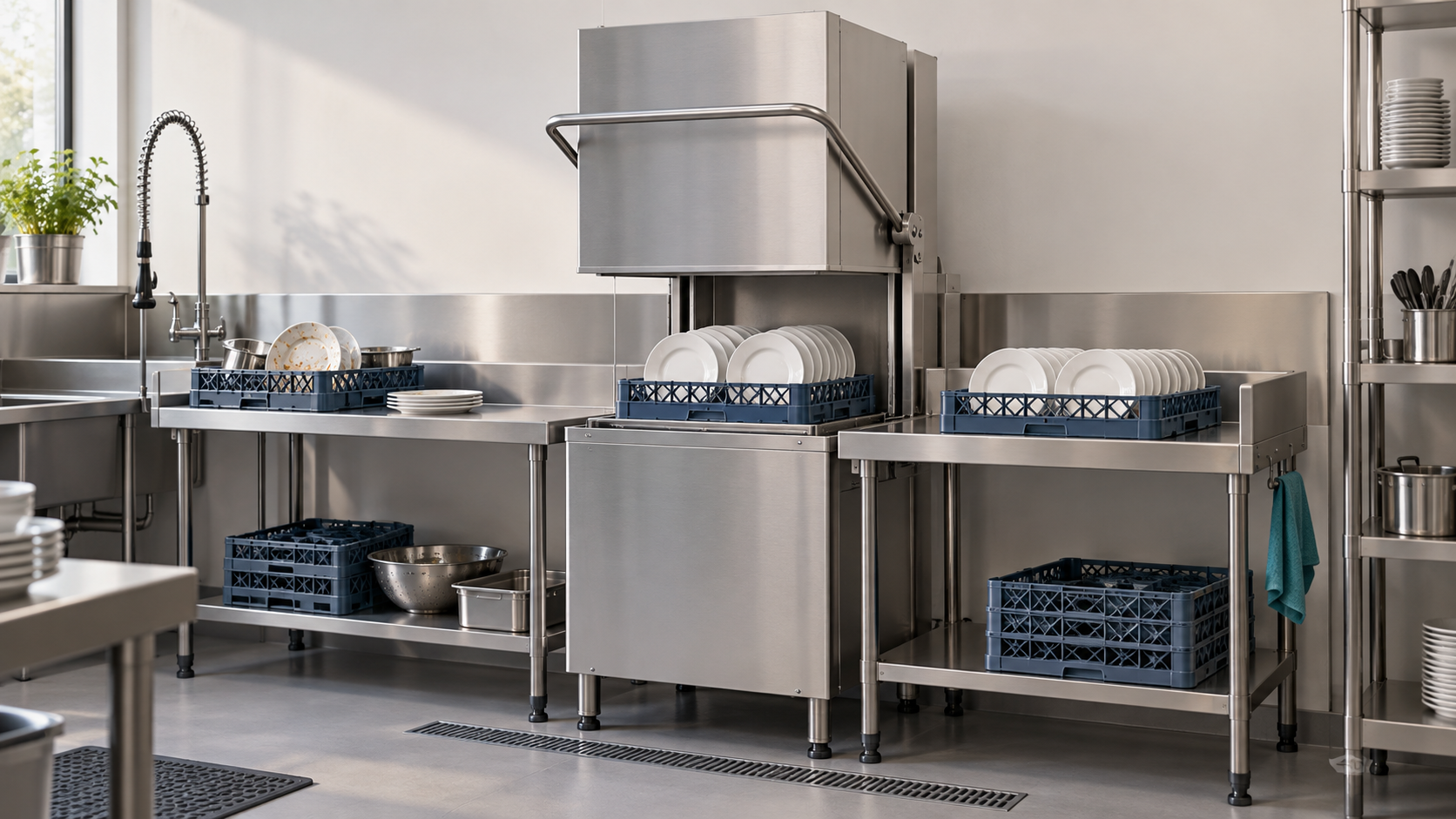
Estimated reading time: 6 minutes
A commercial dishwasher's hourly rack figure tells a Gulf restaurant buyer only part of the story. The machine still needs to fit the restaurant's plates, work with the available water and power, and keep pace with staff during the busiest service. For dealers sourcing from China, those details belong in the first quotation. A lower machine price is hard to judge while treatment equipment, installation and local support remain undecided. Start with what comes back from the dining room, then work through the wash-up area with the restaurant and its installer.
- Size the wash-up operation around peak service and the dishes being used.
- Price water treatment and rinse heating with the machine.
- Settle the electrical version, import requirements and service arrangements before ordering.
Follow a rack through the kitchen
The largest plate and tallest glass are useful starting points. Their dimensions, the rack layout and the machine's usable opening determine what can be loaded. Glassware and heavily soiled cookware also deserve separate attention in the brief.
Manufacturer categories make the distinction clear. Hobart China's AM60K is a hood dishwasher; MEIKO's Saudi M-iClean UM sheet describes an undercounter glasswasher. Both offer useful technical information, but they serve different tasks. Their headline output figures alone would make a poor comparison. Hobart AM60K; MEIKO Saudi technical sheet.
Now follow a rack from dirty returns to storage. Someone has to scrape, load and unload it, with space for the next rack at each step. A walk-through during peak service makes the staffing and possible queues easier to discuss. For the equipment demonstration, use representative dirty dishes and the proposed racks. Agree beforehand what counts as an acceptable result, including cleanliness, visible residue and breakage.
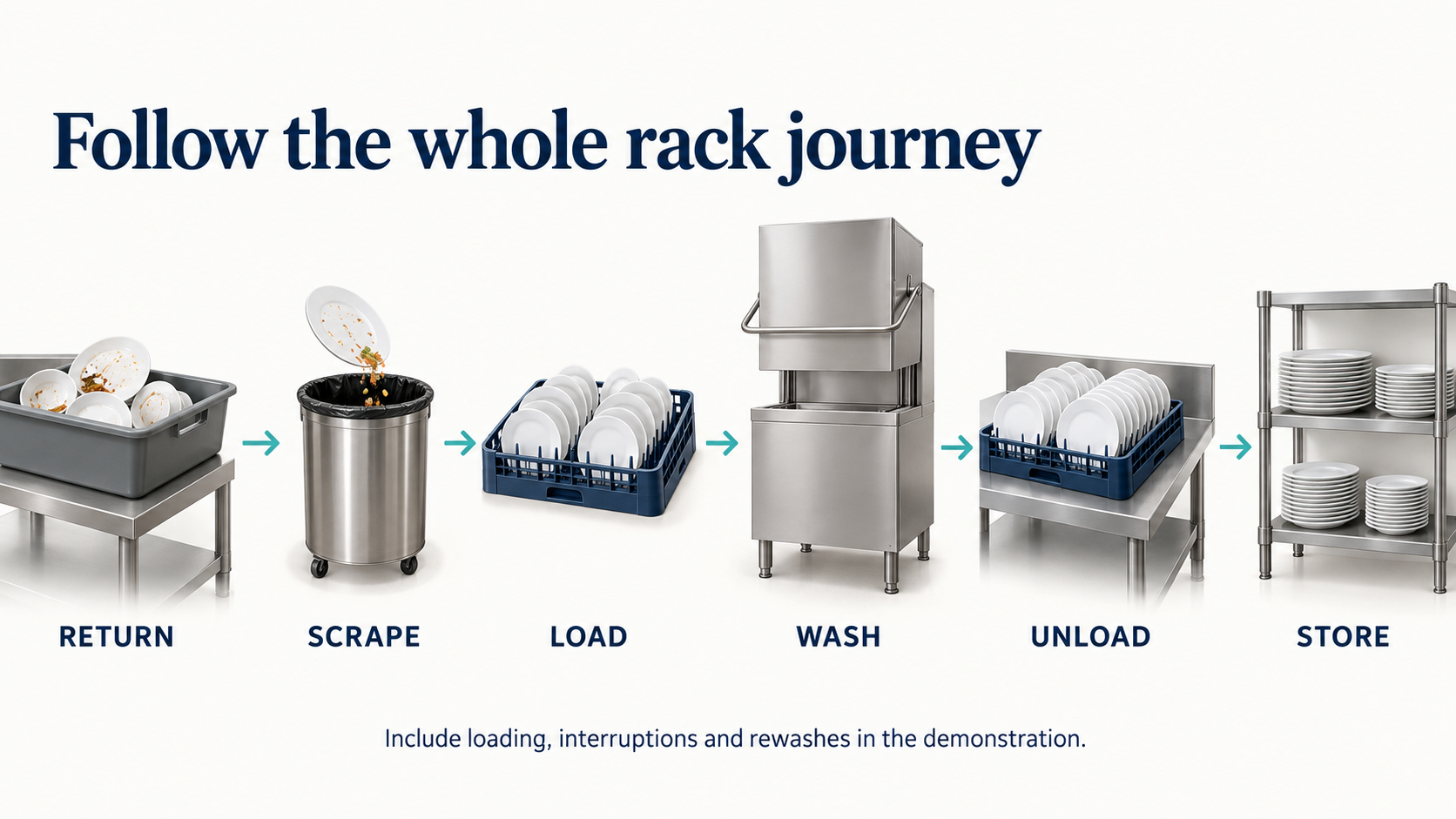
From dirty returns to clean storage: include loading, interruptions and rewashes in the demonstration.
What sits behind “racks per hour”?
MEIKO calls the rack output in its Saudi M-iClean UM sheet theoretical. That wording matters when a dealer quotes capacity to a restaurant: the published figure is a reference, while the site's output depends on the working conditions. This particular sheet dates from 30 March 2020, so a purchase needs current technical information. MEIKO, page 1.
A useful capacity discussion covers the programme used, the water conditions and any waiting time for heating. During the trial, record loading and unloading separately, then count acceptable finished racks over the agreed period. Keep interruptions and rewashes in the record. Otherwise, the figure says little about how the station will work through a busy service.
Rinse readiness is part of that discussion. Hobart declares a temperature-controlled rinse above 82°C for the AM60K. The figure applies to that model; it is neither a universal Gulf operating requirement nor proof of sanitation at a customer's site. The offered machine needs its own explanation of how rinse readiness is controlled. Hobart AM60K.
The water report belongs beside the quotation
Water treatment is easier to price once the supplier has a report from the proposed connection. The offer should state acceptable inlet conditions, the recommended treatment and the consumables and maintenance it needs.
Softening and reverse osmosis do different jobs. Winterhalter explains that a softener uses ion exchange to remove hardness minerals such as calcium and magnesium; reverse osmosis uses a membrane to remove a wider range of impurities. The choice needs to suit the restaurant's dishes, finish expectations and servicing arrangements. Winterhalter water-treatment guide.
MEIKO's cited Saudi glasswasher configuration specifies soft warm water at 0 to 3°dH. Keep that limit attached to this configuration rather than carrying it across to every dishwasher. The same sheet lists a booster pump and boiler heater separately. MEIKO, page 1.
So “booster included” needs a little more detail in the offer: the rinse heater, any rinse-pressure pump, required inlet temperature and total connected load. Those are the details the installer can compare with the site.
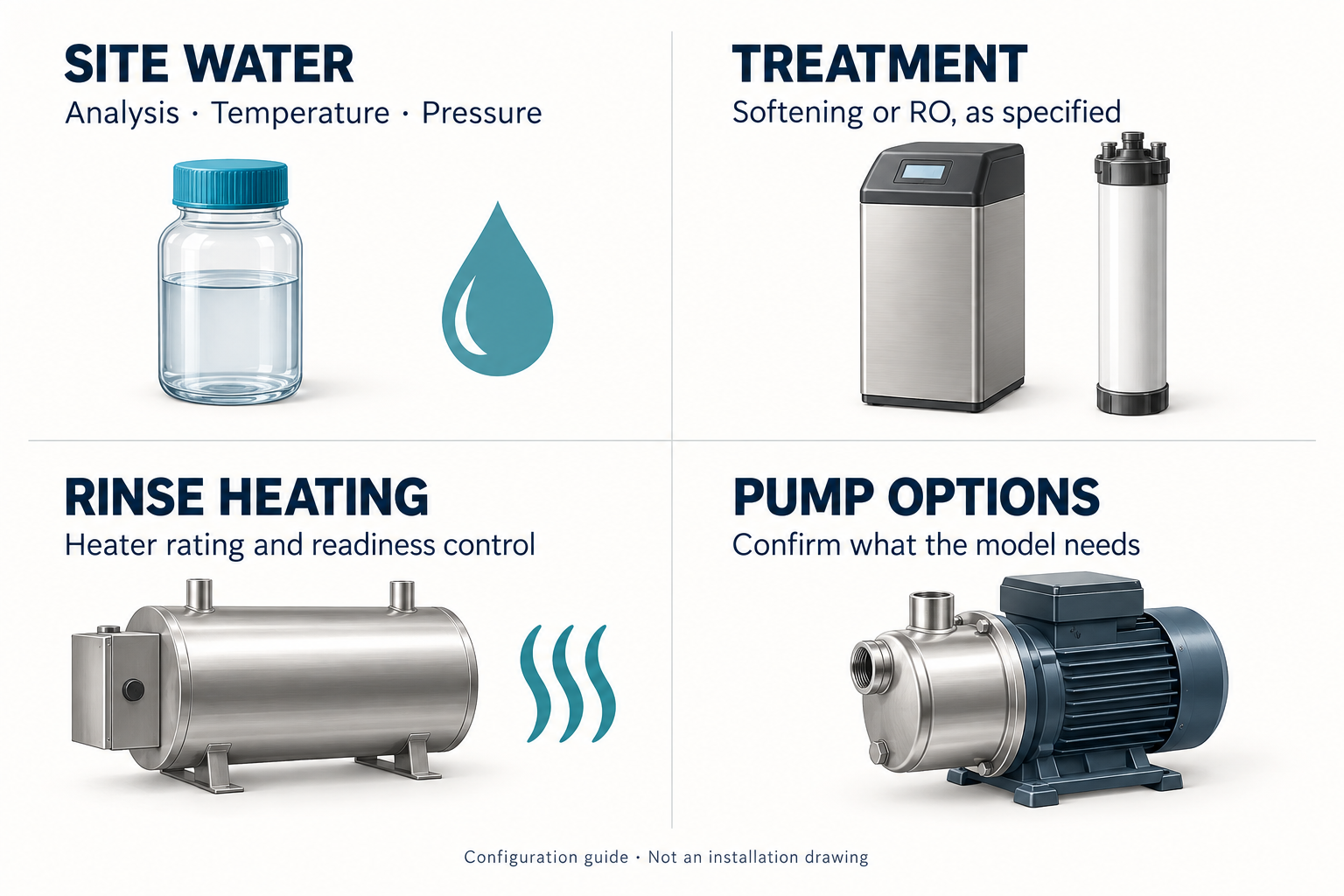
Water treatment, rinse heating and pump options need to match the selected model and the site.
Order the right electrical version
Hobart publishes the AM60K as 380V, 50Hz, 3N. MEIKO's Saudi sheet specifies 400V, 60Hz, three-phase with neutral and protective earth. The exact version belongs on the order, supported by the nameplate, wiring information and installation sheet for the project electrician to review. Hobart; MEIKO.
The paperwork also needs to match the destination. IEC 60335-2-58:2017 covers safety of commercial electric dishwashing machines. Its scope helps when reviewing a test report; a reference to the standard alone does not certify a model.
For Saudi orders, the SASO technical-regulation directory is a starting point. Dishwashers also appear on SASO's IECEE national-recognition page. The importer or conformity body needs to establish the route for the specific commercial machine and intended use before purchase. Other GCC destinations require their own review. The Saudi kitchen-equipment RFQ guide covers the broader import brief.
Compare the complete installed offer
Put the restaurant's requirements next to each supplier's proposal. This buying brief keeps the machine, site work and handover in the same conversation.
| Buying decision | Restaurant / installer | Supplier proposal |
|---|---|---|
| Ware and racks | Largest items, soil, glassware needs | Machine category, rack layout, usable opening |
| Peak service | Return pattern and available staff | Programme, output basis, demonstration conditions |
| Inlet water | Water analysis, temperature, running pressure | Accepted limits and treatment arrangement |
| Rinse heating | Available hot water and electrical capacity | Heater rating, readiness control, any rinse pump |
| Installation | Power supply, drainage, ventilation, access | Exact model, connection plan, drain and clearance requirements |
| Handover | Local service contact and operator availability | Dosing setup, training, spare parts and warranty responsibilities |
Treatment equipment, racks, dosing accessories, installation and commissioning all belong in the price comparison. Each party's scope should be clear before the dealer gives the restaurant a final offer.
Know who will answer the service call
Before ordering, name the people responsible for installation checks, dosing setup and operator training. The maintenance instructions and parts list should match the exact model revision. The local service provider also needs to know which repairs it can handle and which need factory support.
At handover, keep a commissioning record of the delivered configuration, measured site conditions, selected programmes and demonstration results. Save the agreed specification for repeat orders, with any later component or setting changes identified by the supplier.
Planning a restaurant project? Send DDNZ the city, opening date, photos and dimensions of the dishes, peak-service workload, water report and electrical supply. Existing offers and your proposed local service arrangement help define the enquiry. Discuss your commercial kitchen sourcing brief.
Sources accessed 16 September 2026. Manufacturer examples refer to the cited configurations. Images are original AI-generated illustrations.
Reviewed by Huang Matthew · DDNZ Global Trade Co., Ltd.