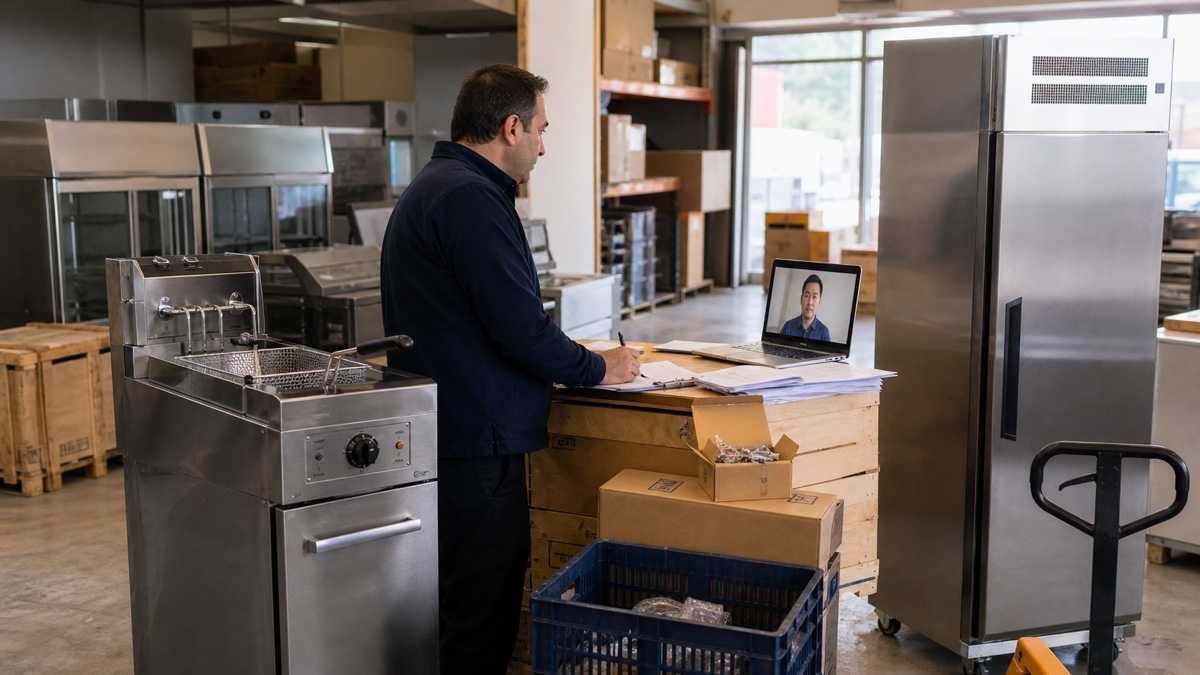
Verified 17 August 2026 · For commercial kitchen importers, dealers, distributors and project contractors in Türkiye
For a Turkish dealer, the question is not simply whether a new machine from China costs less than used local stock. The real decision is which route protects landed margin, preserves the dealer’s customer relationship and can be supported after sale. Used local machines may fill an urgent order with little import lead time, but their condition and repeatability vary. A new China supply line can support repeat orders, private label and coordinated projects, but only when the exact models, costs, spare parts, inspection and channel rules are controlled before deposit.
Three-point summary
- Compare sellable configurations and landed channel margin, not factory price against a local listing.
- Use local used stock for verifiable one-off opportunities; use new China supply where repeatability, project coordination or private label creates value.
- Treat supplier verification, model locking, spare parts, claims handling and customer protection as commercial requirements—not administrative extras.
Why Turkish dealers are the primary buyer
Türkiye’s current B2B sourcing ecosystem reflects this audience. The official ZUCHEX 2026 page addresses importers, distributors, dealers, wholesalers, resellers and buying offices, and highlights OEM, private-label and long-term distributor relationships. HOSTECH’s current scope includes industrial kitchen equipment, refrigeration, energy-efficiency systems and turnkey project solutions.
That matches the practical division of work. The Turkish partner owns local market knowledge, customer acquisition, installation, service and collection. A China-side supply-chain partner should help verify manufacturers, compare models, consolidate factories, inspect goods and coordinate export—not bypass the dealer’s local channel.
Calculate dealer margin after channel costs
A low supplier quote does not prove a profitable SKU. Use the same quotation date, currency and commercial scope for every candidate.
Expected dealer margin = net local selling price − landed and channel cost − warranty/claim reserve
Include product, China handling, packing, consolidation, freight, import and local charges, delivery, installation, spares, finance and expected after-sales work. The Turkish importer should determine the actual GTIP and tax treatment.
| Dealer question | New supply from China | Used local stock | Evidence before purchase |
|---|---|---|---|
| Can I quote the same model again? | Possible when model, components and change control are locked | Usually limited by the individual machine and its condition | Model code, serial/batch method and replacement policy |
| Can I protect my margin? | Requires full landed-cost and claim reserve | Requires realistic repair, cleaning and downtime allowance | Cost sheet with unresolved risks shown separately |
| Can my technicians support it? | Depends on manuals, diagrams, parts and supplier response | Depends on model history and local parts availability | Parts list, service contact and technician review |
| Can I protect my customer relationship? | Requires agreed contact handling and dealer-facing documents | Usually controlled locally | Written communication and channel terms |
| Can I scale the product line? | Possible with repeatable specifications and quality control | Difficult when every asset is different | Golden sample, inspection standard and reorder record |

Compare equivalent products, not category names
Current Turkish fryer listings illustrate how quickly price comparisons become misleading: the same category page contains 3 L, 5 L, 8 L and twin-tank configurations. Türkiye’s May 2026 official mechanical-installation reference also separates commercial electric fryers by capacity and minimum power. These are not interchangeable units.
China supplier records show the same problem. Linkrich’s LR-EF52x1 is listed at 220 V/50 Hz, 7.5 kW and 52 L, while Shinelong’s FSFR0504E62 is listed at 220 V/50–60 Hz, 5 kW and 6 L×2. Both are called electric fryers; neither the product name nor voltage establishes equivalent output or site suitability.
A dealer comparison sheet should therefore lock:
- usable capacity and intended menu duty;
- output or recovery requirement;
- overall and packed dimensions;
- electrical phase, voltage, frequency and connected load;
- gas type and pressure where applicable;
- ventilation, water and drainage interfaces;
- material and finish where commercially relevant;
- included baskets, trays, shelves, feet, valves and cables;
- warranty scope, critical spare parts and after-sales route.
Decide which products belong in each supply route
Used local stock can be useful for urgent projects, price-sensitive one-off buyers or equipment that can be fully inspected and supported locally. New China supply is more attractive when the dealer needs a repeatable range, coordinated dimensions, private label, batch consistency or a multi-store/project rollout.
| Equipment group | Possible local-stock role | China-sourcing requirement |
|---|---|---|
| Stainless tables, sinks and shelving | Urgent or one-off dimensions when condition is visible | Approved drawings, finish/weld standard, packing and batch dimensions |
| Fryers, griddles and ranges | Verified fuel, controls and loaded operating test | Exact duty, utility interface, safety file, spares and test method |
| Commercial refrigeration | Documented service history, temperature test and local parts | Ambient basis, temperature duty, refrigerant, controller and service plan |
| Combi ovens, dishwashers and controlled equipment | Local technician can prove boards, pumps and service support | Complete model dossier, commissioning plan and critical-parts package |
Build the first China order around repeatability
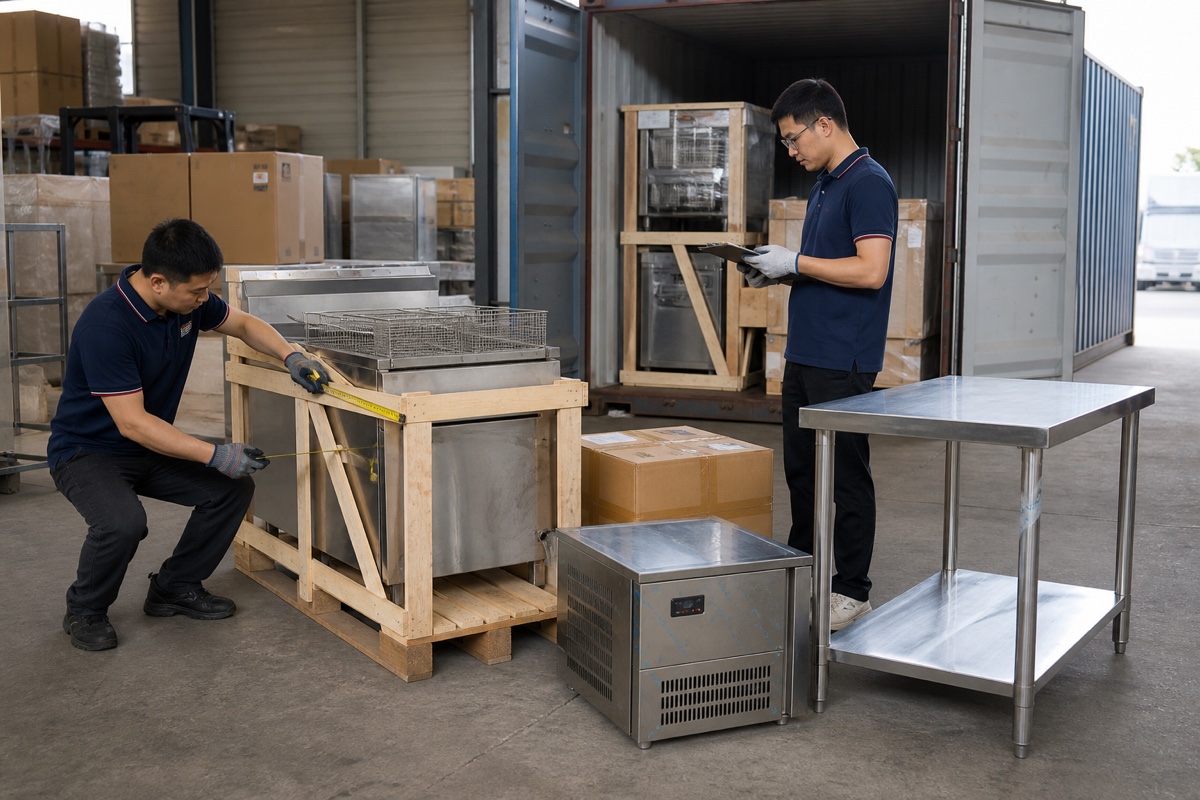
A mixed container should not be a random collection of low quotations. Start with a small number of anchor SKUs that match the dealer’s actual sales and service capacity. Add complementary products only after checking packing volume, utility variants, parts overlap and the risk of unsold stock.
Before paying a deposit, require:
- legal supplier identity and verified business location;
- signed model-level quotation and specification;
- drawings, manuals, wiring or gas information and nameplate layout;
- golden sample or agreed reference where practical;
- critical spare-parts list and claim-handling procedure;
- inspection checklist with pass/fail criteria;
- export packing, carton/crate marks and loading plan;
- rules for substitutions, engineering changes and non-conformity remedies.
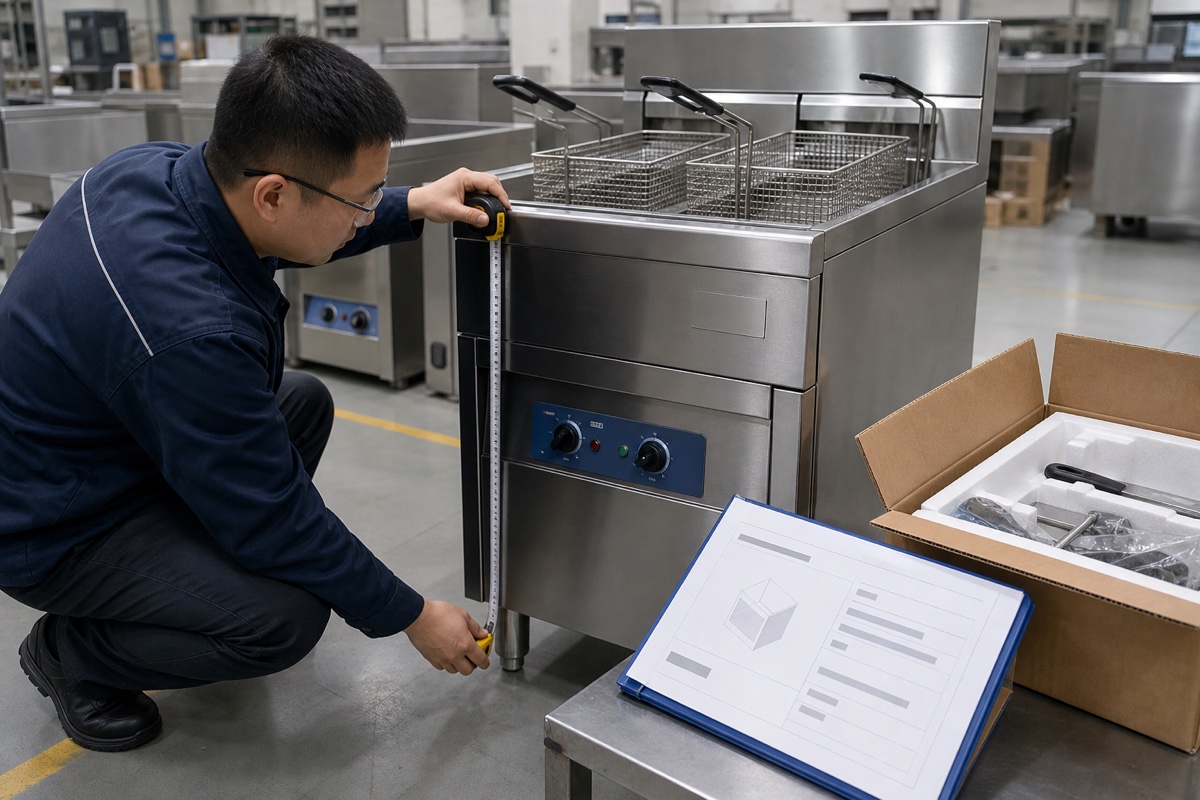
A cheaper replacement model is not automatically acceptable. Any substitution should return to the dealer for written approval with a new comparison of capacity, utilities, components, documents and landed margin.
Protect the dealer’s local channel
The Turkish dealer should remain the commercial owner of its customer relationship. China-side RFQs can use project codes or limited customer details until the commercial framework is agreed. Dealer-branded product sheets, controlled sample distribution, documented communication routes and written territory or customer-handling terms can reduce channel conflict.
Keep the Türkiye import check model-specific
Türkiye’s Ministry of Trade states that certain electrical/electronic products and gas-burning appliances requiring CE marking are checked at import under the applicable 2026 rules. The route depends on the exact product and GTIP.
The Turkish importer or customs representative should confirm classification and required documents before the balance payment. Supplier statements, brochure logos or documents for a different model or market should not be treated as final clearance evidence.
A dealer-focused release sequence
- Define the sellable range. Use real customer demand, target selling price and service capability.
- Shortlist equivalent models. Reject quotations that do not answer the same duty sheet.
- Verify suppliers and channel terms. Confirm identity, manufacturing role, communication and substitution rules.
- Calculate margin after all channel costs. Include parts, claims, finance and slow-moving stock.
- Inspect and release by evidence. Tie balance payment to the exact model, packing and agreed tests.
- Preserve the reorder file. Store the approved specification, photos, parts and inspection record for the next shipment.
DDNZ can work confidentially behind Turkish importers, dealers and project contractors as their China-side sourcing, supplier-verification, consolidation and export partner. Request a confidential commercial-kitchen sourcing and mixed-container review.
Frequently asked questions
Should a Turkish dealer always import new equipment instead of buying locally?
No. Local stock may be better for urgent or fully inspectable one-off needs. China sourcing becomes more valuable when the dealer needs repeatability, coordinated projects, private label or a scalable product line.
Can equipment from several Chinese factories share one shipment?
It can, but purchase terms, delivery to the consolidation point, packing, inspection, document control and loading responsibility must be coordinated before production.
Is the lowest China quotation the best dealer offer?
Not necessarily. The dealer must compare equivalent output and utilities, then include freight, import costs, parts, warranty exposure, claims and working capital before judging margin.
Sources
- ZUCHEX 2026 — B2B buyer, importer, dealer and private-label sourcing profile
- Republic of Türkiye Ministry of Trade — product groups subject to 2026 import safety controls
- Türkiye YFK — May 2026 mechanical-installation unit-price and specification list
- Makinecim — current fryer listings snapshot
- Linkrich — LR-EF52x1 supplier specification
- Shinelong — FSFR0504E62 supplier specification
- HOSTECH by TUSID — 2026 industrial-kitchen and turnkey-project scope