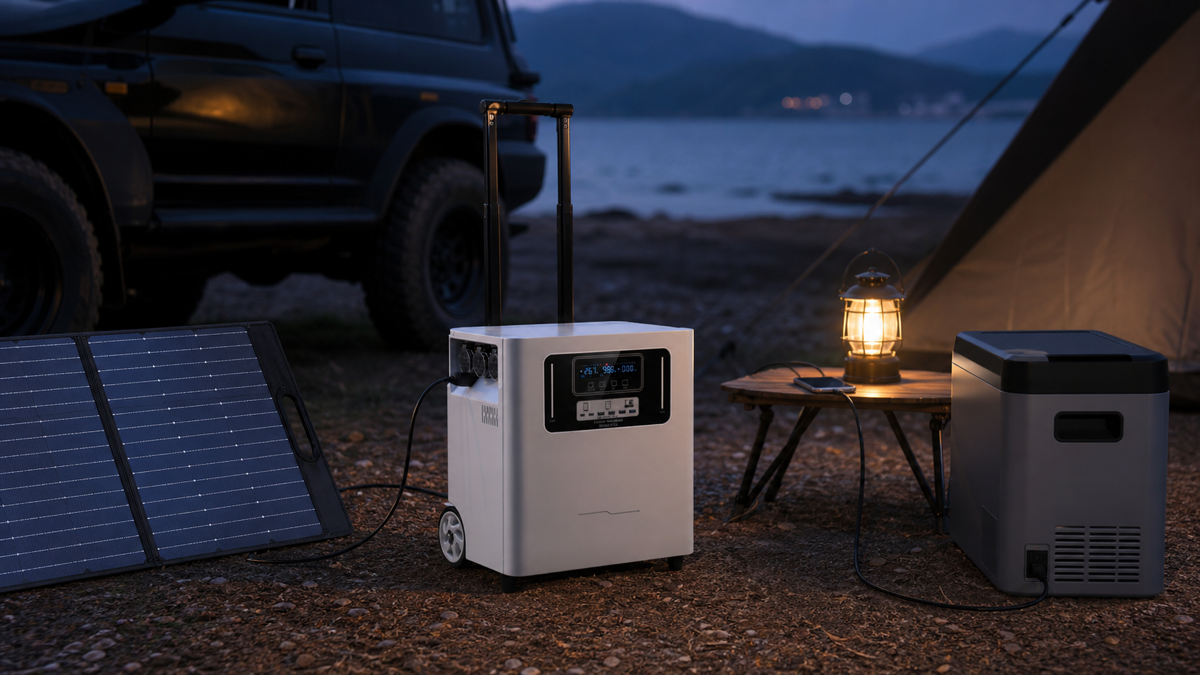
Three points for importers and dealers
- Separate portability from autonomy. A unit that is easy to carry may not protect a fridge and freezer through a long outage.
- Sell from measured loads, not catalogue wattage. Output watts and stored watt-hours answer different questions.
- Treat solar as a charging system. Panel voltage, current, connector, weather and controller limits all affect what reaches the battery.
What buyers are asking this month
Recent discussions show the same request appearing again and again: “I want something for camping, but I also want it to keep the fridge or freezer running when the grid goes down.”
In an August 2026 portable-power-station discussion, the buyer’s camping list was modest—phones, LED lights and a vehicle-battery trickle charge—while the outage requirement included a refrigerator and deep freezer for as long as 16 hours. The buyer quickly discovered that the smaller option felt excessive for camping, yet the larger option made more sense for the house.
Other recent outage threads focus on a minimum survival set rather than “powering everything”: cold food, a router, a few lights and sometimes a fan. That is a useful commercial signal. Dealers need a range that is easy to explain at the counter, not a wall of batteries differentiated only by maximum watts.
Social posts are demand signals, not performance evidence. The final product promise still has to come from a repeatable test on the exact model.
A two-tier range that dealers can explain
| Range | Typical buyer job | What the dealer should verify | Do not promise |
|---|---|---|---|
| Mobile / DC-first | Phones, LED lighting, laptop, camera gear and a 12V portable fridge during camping or field work | Carrying weight; delivered DC energy; USB-C and regulated 12V limits; AC inverter idle draw; car and solar charging; cable and connector quality | Whole-home backup or long refrigerator/freezer autonomy |
| Essential backup | Refrigerator or freezer, router, lights and selected small appliances during a power cut | Measured 24-hour appliance energy; start-up surge; delivered AC energy; expansion options; recharge time under stated conditions; safe indoor operating limits | Runtime based only on battery nameplate Wh or inverter W |
| High-draw qualification | Electric stove, kettle, electric blanket, microwave or room air-conditioner | Exact appliance nameplate; measured running and start-up demand; duty cycle; required hours; inverter limit; battery temperature and recharge plan | “Runs all appliances” without a model-by-model load budget |
The first two rows can become the core dealer assortment. The third is a qualification path, not a casual bundle. A power station may be able to start an electric stove but still exhaust its stored energy quickly. An electric blanket may draw less, but its controller, heat setting and required overnight hours still matter.
Start with energy, not socket count
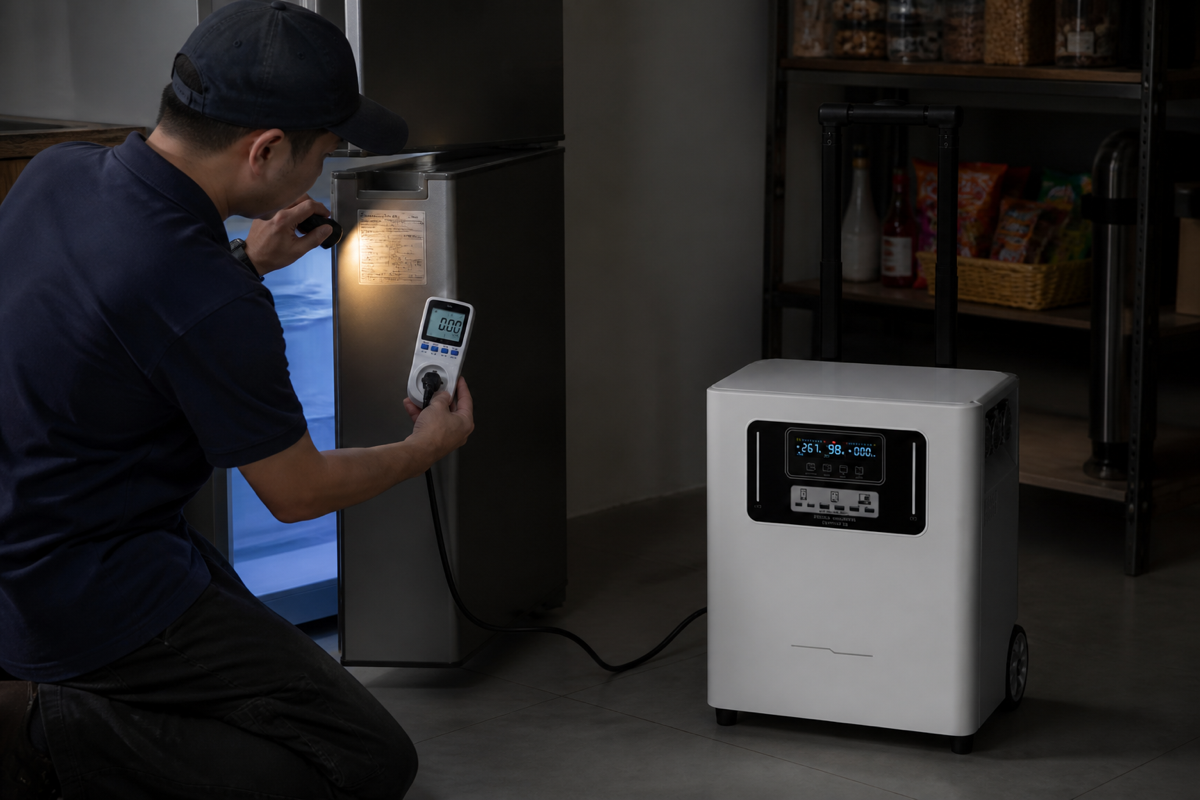
Watts describe how much power a load needs at a moment. Watt-hours describe stored or consumed energy. A large inverter cannot create longer runtime if the battery does not hold enough usable energy.
For a steady load, the basic planning relationship is:
Estimated runtime = measured delivered energy in Wh ÷ measured average load in W
Use delivered AC or DC energy from the actual sample, not only the cell-level nameplate figure. For cycling appliances, measure energy over time. A refrigerator, for example, should be tested over 24 hours at an agreed ambient temperature, setpoint, food load, ventilation condition and door-opening pattern. DDNZ’s existing portable-fridge power-chain guide explains that method in more detail.
The RFQ should also record start-up demand. Compressors and some motors can demand more power when starting than during normal running. If the supplier claims a surge capability, ask how long it is available and request a test with the intended appliance category.
Solar charging is a compatibility test
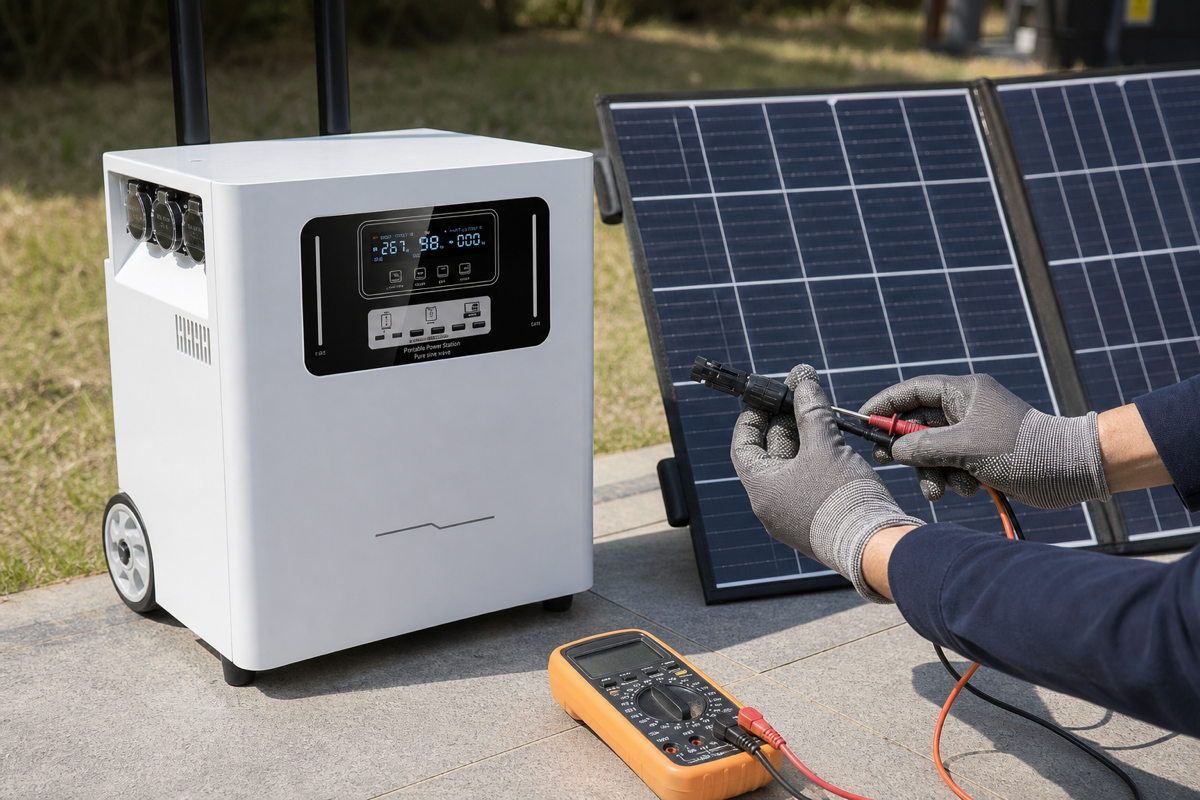
“Solar rechargeable” is not a complete specification. The importer needs the station’s accepted open-circuit voltage range, maximum current, maximum solar power, connector, polarity and permitted panel configuration.
Current manufacturer records show why this matters. The EcoFlow DELTA 3 Plus manual specifies two solar inputs with defined voltage, current and power limits. The BLUETTI AC200L manual publishes a different input window and states that solar charging time varies with weather, sunlight and panel orientation. These are disclosure benchmarks, not a recommendation of either brand.
The NREL PVWatts model also uses weather, system losses, module and thermal effects when estimating photovoltaic output. A panel’s advertised watts therefore should not be copied into an “hours to full” promise without a test condition.
For mains charging, freeze the destination voltage, frequency, plug and allowable input current. Confirm whether the offered unit can charge and supply a load simultaneously, and whether any backup-switching claim applies to the exact regional model.
The supplier file to collect before a deposit
Ask shortlisted factories to submit one model-level pack:
- Exact model code, regional voltage and outlet layout.
- Battery chemistry, rated Wh, cell and pack identification, and BMS protection list.
- Delivered-energy test results through both AC and DC outputs.
- Continuous output, surge level, surge duration and test load.
- Solar-input voltage/current/power window, connector and recommended panel wiring.
- AC, vehicle and solar recharge tests with starting state of charge and test conditions.
- Charging, discharging and storage temperature limits.
- Sample serial number, firmware version, app requirements and offline functions.
- Warranty process, replaceable parts and after-sales responsibility for the destination.
- Packing dimensions, gross weight, drop/handling evidence and spare-cable availability.
Compare at least two samples on the same test sheet. Do not accept a report that names a product family while the quotation uses a different model suffix.
Keep the transport check practical
Portable power stations contain lithium batteries, so the product file and the transport file must identify the same battery and finished-product model. The current UNECE Manual of Tests and Criteria, Revision 8 and Amendment 1 is the official reference set for UN 38.3. The test summary includes manufacturer and laboratory details, report identification, battery description, Wh rating, model numbers and results.
Collect the current UN 38.3 test summary, safety data, transport classification, packing method and carrier acceptance information before promising a shipping schedule. The final route and shipment configuration still need a dangerous-goods review; this article does not prescribe one global booking method.
Building a portable-power range for your market? Send DDNZ the destination, dealer channel, target loads, backup hours, solar conditions and expected order volume. We can compare Chinese suppliers on one load-and-recharge test: Request outdoor-products sourcing support
Sources and verification
Last verified: 21 August 2026.
- Reddit — camping and home-outage power-station discussion, 6 August 2026
- Reddit — sizing advice based on measured running and surge load, August 2026
- NREL — PVWatts V8 model inputs
- UNECE — Manual of Tests and Criteria, Revision 8 and Amendment 1
- EcoFlow — DELTA 3 Plus user manual
- BLUETTI — AC200L user manual