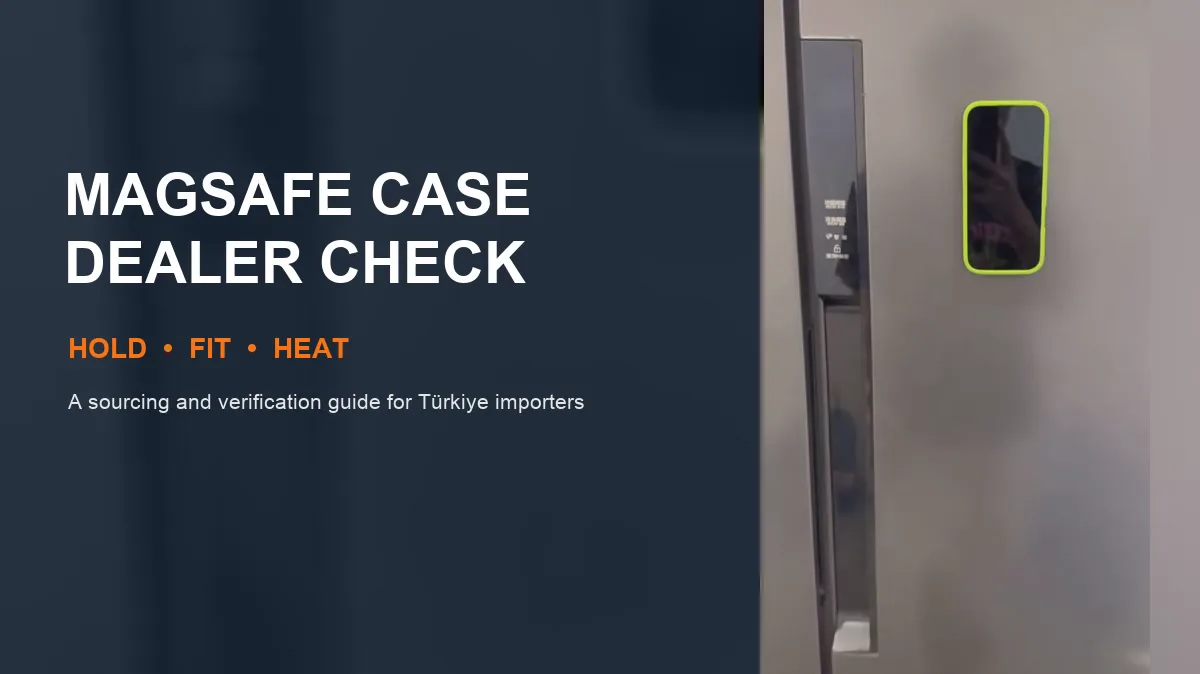
Türkiye dealers do not need another MagSafe case catalogue. They need a way to tell whether a quoted SKU will hold accessories reliably, align with the intended charger, fit the correct iPhone model and arrive in retail-ready condition. The safest buying decision comes from tying every price to an exact model, construction and test record—not from accepting “strong magnet” or “fast charging” as complete specifications. This guide shows a practical pre-order check for import agents, distributors and mobile-accessories dealers sourcing MagSafe-compatible cases from China.
In short
- Lock the quote to a model-by-model SKU sheet before comparing price.
- Treat attachment videos and thermal images as evidence inputs, not final proof by themselves.
- Approve the order only after sample checks cover magnet hold, accessory alignment, charging heat, fit, finish, packing and reorder terms.
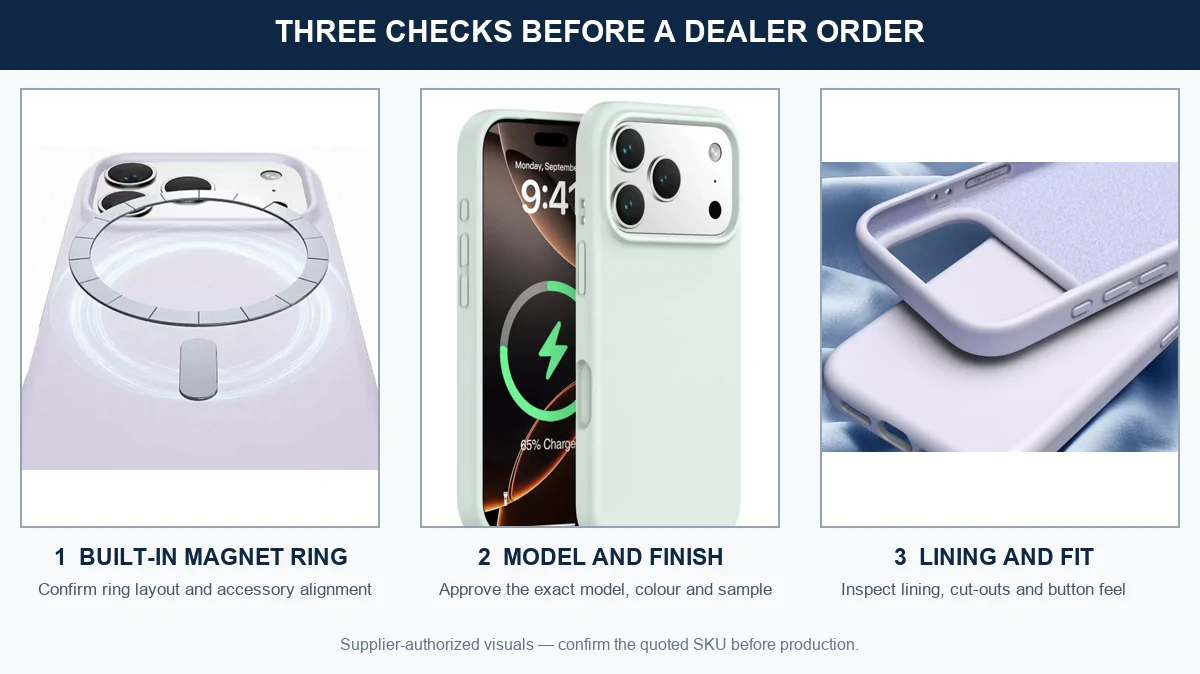
Start with a dealer specification, not a catalogue image
Two cases can look almost identical online and still behave differently in daily use. The built-in magnetic-ring construction, its fixing method, the case’s rear thickness, the camera opening and the button geometry all matter. A dealer therefore needs a quotation that names the exact supported phone models, colour range, material, ring construction, retail pack and order quantity per model and colour.
Supplier renders are useful for confirming appearance, but they should not be the only fit evidence. Ask for current production samples and a model matrix. Check the camera island, buttons, speaker and charging-port openings, corner fit and whether the back remains flat after installation.
Apple’s dimensional drawing for the iPhone 16 Pro Max, for example, gives model-specific accessory limits: it states that the case backside should not exceed 2.1 mm for full functionality and places restrictions on metal and rear magnets. That number is useful for that drawing—not a universal specification for every iPhone. Dealers should request the relevant model drawing and sample check instead of copying one limit across a whole range.
Magnet hold: film the scene, then define the test
The supplier material reviewed for this guide includes a phone case holding a phone against a refrigerator door. It is a clear, easy-to-understand scene demonstration and can help a buyer see that the sample has meaningful attachment force on that surface.
It is not, however, a calibrated magnet-strength test. The result can change with the phone model, metal surface, contact area, case construction and how the phone is placed. A purchasing specification should therefore define a repeatable sample check.
Use the same phone model, the same case SKU and the same accessories for every comparison. Record the surface, orientation and test duration. Check not only whether the case attaches, but also whether a wallet, stand or charger sits centrally and resists light movement in the way your customers expect. Keep the video with the sample number and supplier quotation so the evidence remains traceable.
For dealer approval, “strong magnet” should become a documented pass condition. The purchase order can then refer to the approved sample and test method rather than a marketing adjective.
Charging heat: use thermal images to ask better questions
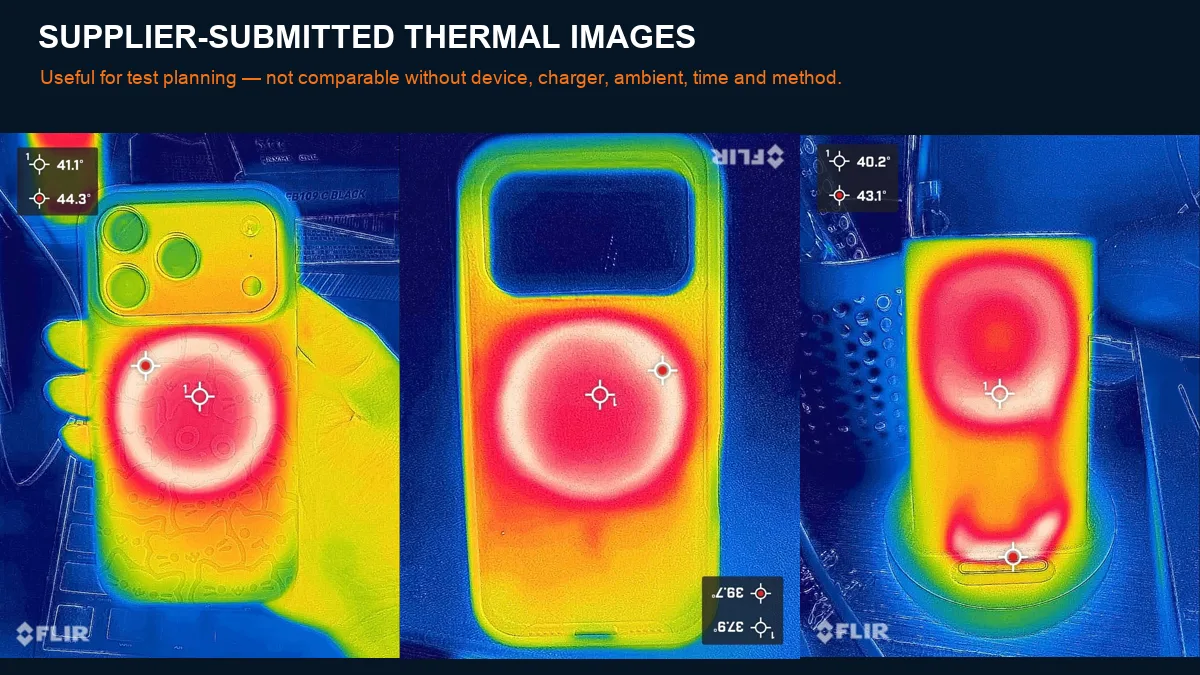
The supplier also provided thermal-camera images of charging setups, including an example described as a low-quality iron-ring case and images showing concentrated heat around the charging area. These images are relevant to the sourcing risk: ring material, alignment, obstruction and charger compatibility can affect the charging experience.
They do not support a stand-alone claim that one case is safer than another. To compare temperatures, the phone, charger, power adapter, starting battery level, ambient temperature, charging time, case SKU and measurement method must all be controlled. Without that information, a thermal image should be used to plan a test—not to publish an absolute performance ranking.
Apple notes that an iPhone and MagSafe charger may become warmer while charging, and that software may limit charging above 80% when the battery becomes too warm. The Wireless Power Consortium’s Qi specification history also highlights magnetic accessory covers, mechanical obstruction testing and improved controls for power loss and foreign-object detection in recent Qi releases.
For a dealer sample review, record charging alignment and stability, observe temperature over a defined period and compare samples under the same setup. If the supplier claims Qi or Qi2 certification, verify the exact product in the WPC certified-product database rather than relying on a logo in a catalogue.
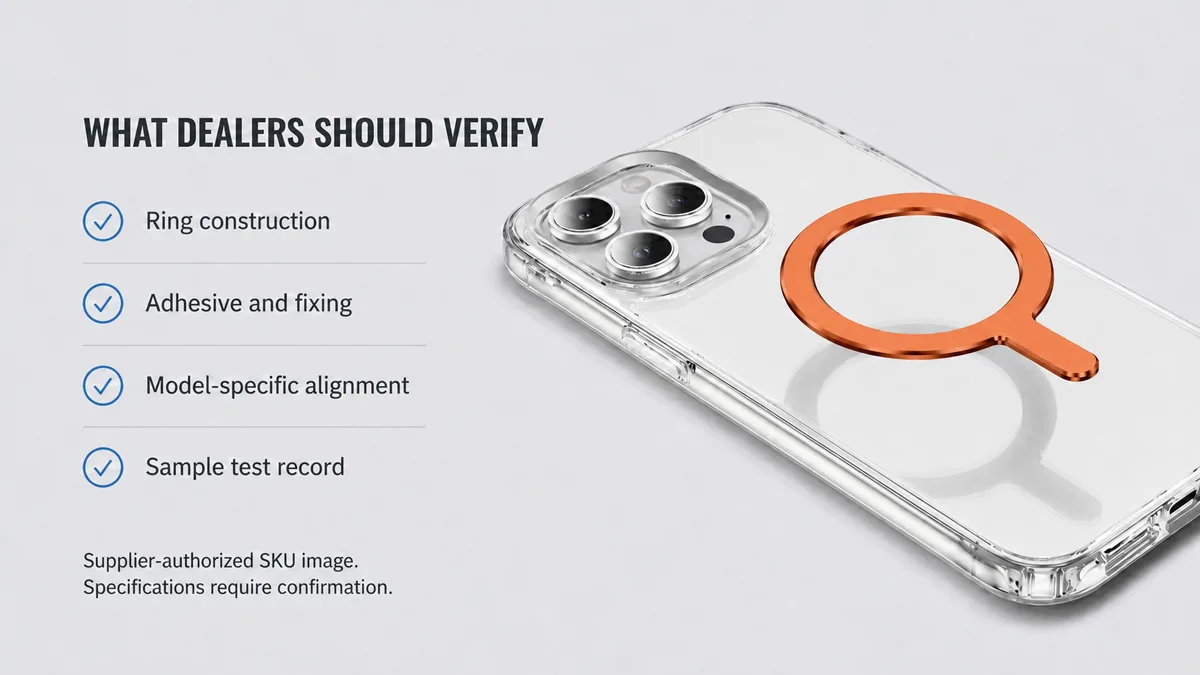
A practical approval matrix for Türkiye importers
| Check | Ask the supplier for | Verify on the sample | Buying decision |
|---|---|---|---|
| Model fit | Exact iPhone model/SKU matrix | Camera, buttons, ports, corners and back flatness | Approve by model, not by series name |
| Magnetic construction | Ring material, layout and fixing method | Alignment and consistent attachment with intended accessories | Bind the order to the approved construction |
| Attachment scene | Video using the quoted SKU | Repeat with the same phone, surface and orientation | Treat as a repeatable scene check, not a force rating |
| Charging and heat | Charger and adapter used, test duration and starting conditions | Run the same setup across samples and record observations | Reject unsupported “faster” or “cooler” guarantees |
| Material and finish | Case material, colour and surface treatment | Feel, odour, scratches, deformation and colour consistency | Set visual defect limits before production |
| Retail packing | Pack type, barcode/label area and included items | Confirm model label and package protection | Approve a packing sample |
| MOQ and replenishment | Quantity per model/colour and reorder lead time | Match the assortment to your sales plan | Compare landed assortment risk, not unit price alone |
This matrix is designed for a dealer conversation. It helps purchasing teams compare quotations that otherwise appear similar while hiding different model coverage, construction and quality-control commitments.
Make the price quote bind to the product you will receive
A low unit price is not useful if it belongs to a different ring, thinner construction, generic camera opening or different pack. The quotation should identify each SKU and show the selected models and colours, quantity per variant, sample reference, packing, master-carton data, production lead time and defect-handling terms.
For mixed-SKU orders, also confirm how cartons and inner packs will be labelled. A clear model label reduces sorting mistakes when the shipment reaches a Türkiye warehouse or dealer network. Ask how small repeat orders will be handled; a profitable first purchase can still become difficult if replenishment requires a completely different MOQ.
Before paying the production balance, compare the finished-goods sample with the approved reference. The inspection record should cover the agreed fit, magnetic-scene check, charger alignment, surface finish, pack labels, quantities and carton marks. Any substitution should require written approval.
How DDNZ can support the sourcing process
DDNZ can help Türkiye import agents and mobile-accessories dealers turn a broad product request into a traceable purchasing file. The work can include supplier comparison, model and colour assortment planning, sample coordination, inspection criteria, retail-packing checks, consolidation and export shipping from China.
To start, share the iPhone models you sell, target price tier, expected model/colour mix, sales channel, destination and the accessories the case must work with. DDNZ can then organize the supplier questions and sample checks around your commercial requirements instead of sending another unfiltered catalogue.
Sources and evidence boundaries
- Apple — Accessories for Apple devices (design guidance and prototype testing)
- Apple Support — How to use your MagSafe Charger (compatible cases, charging warmth and temperature management)
- Apple — iPhone 16 Pro Max dimensional drawing (model-specific geometry and material limits)
- Wireless Power Consortium — History of the Qi specifications (Qi 2.1 and 2.2 changes)
- Supplier-authorized SKU-matched product images, magnetic attachment video, magnetic-ring construction graphics and thermal-camera frames reviewed by DDNZ on 28 August 2026. Scene demonstrations and supplier thermal frames are labelled according to their evidence limits.