Direct answer
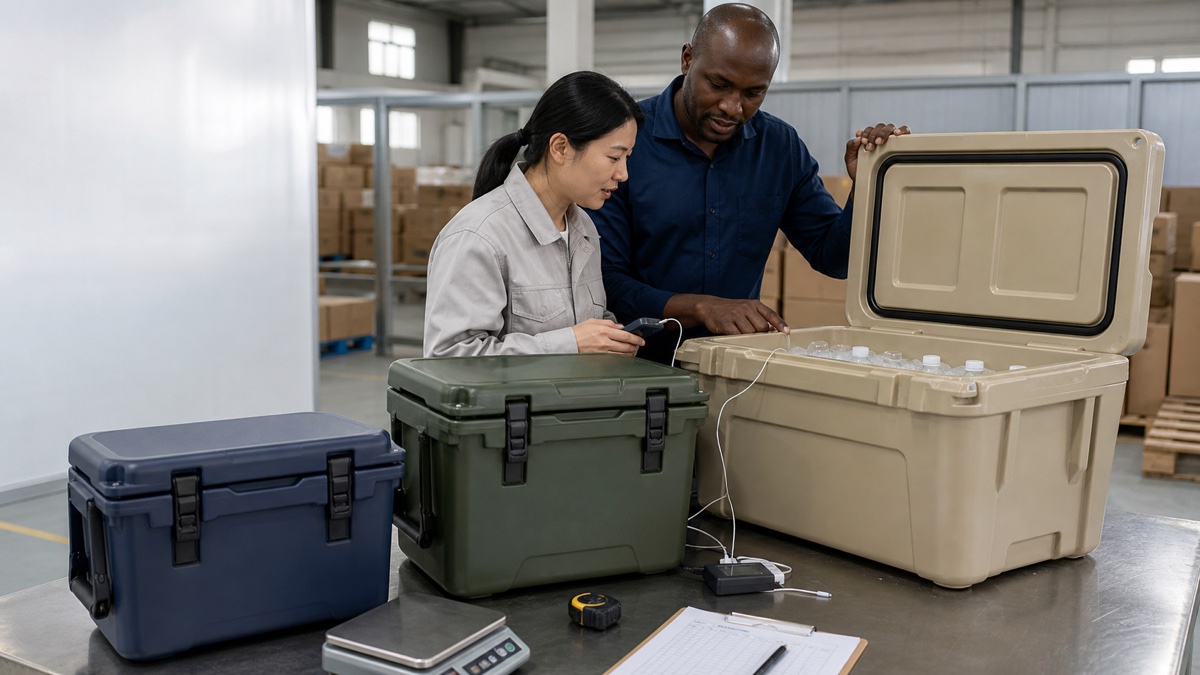
An African distributor buying insulated cooler boxes from China should not compare quotations by unit price or “days of ice” alone. First make every supplier test the exact offered model under the same ambient profile, starting temperatures, ice-to-payload ratio, opening cycle and temperature endpoint. Then compare verified usable payload, empty and loaded weight, export-carton CBM, container quantity and replaceable hardware. Without those controls, a cheaper box may carry less saleable product, lose cooling performance sooner in real heat, occupy more container space or generate costly latch, hinge and gasket returns.
Estimated reading time: 6 minutes
Three-point summary
- A retention claim is not comparable without a method. “Four days” at 25°C indoors with a box full of ice is not the same result as four days in a hotter route with beverages, repeated openings and a defined temperature limit.
- Catalogue litres do not show distributor margin. Verify internal usable dimensions, ice-to-payload ratio, carton cube and actual units per container.
- Lock the exact model before payment. Approve a golden sample, bill of materials, gasket and hardware specification, test sheet, carton and replacement-parts list.
Why this category deserves attention in 2026
Current signals show activity at both the premium-brand and distribution ends of the cooler market. YETI reported that its global Coolers & Equipment sales increased 11% in the first quarter of 2026, while a Sub-Saharan African distributor announced a regional YETI rollout through wholesale and retail channels. These are company-level signals, not proof of continent-wide demand or a forecast for every price segment. They do show why African wholesalers should define their intended resale tier before asking China suppliers for the lowest price (YETI Q1 2026 results; LUKS Group distribution announcement).
A box for low-price beverage resale, a rugged fishing cooler and a premium outdoor-lifestyle product are different commercial offers. The quote should state the target user, payload, route, selling price band and expected warranty support before construction and accessories are compared.
“Four days of ice” is not one test
The active ASTM D3103-20(2025) method for thermally insulated distribution packages explains that performance depends on the actual package, external temperatures, energy source, coolant and product payload. It recommends testing the real package where possible, or using a simulation that closely matches the real payload and coolant (ASTM D3103).
The current WHO cold-box methodology makes the same comparability principle visible: for its specialised vaccine boxes, cold life has a defined ambient temperature, payload system and endpoint. WHO measures one class at a constant 43°C until the warmest storage point reaches 10°C. That is a medical cold-box protocol, not a consumer-cooler certification and not a claim DDNZ applies to ordinary outdoor boxes. It is useful here only because it shows what a defined test looks like (WHO E004).
Supplier pages reviewed on 14 August 2026 illustrate the problem. One China supplier states 4–6 days at 25°C indoors with the cooler fully packed with ice, and also publishes internal dimensions and carton CBM. Another brochure states four days, while a third product page states more than 60 hours; the reviewed pages did not disclose the same ambient, payload ratio, opening cycle and endpoint. These are seller statements, not independently verified results (Boright 33QT; Cool Ride brochure; Polymer 16QT).
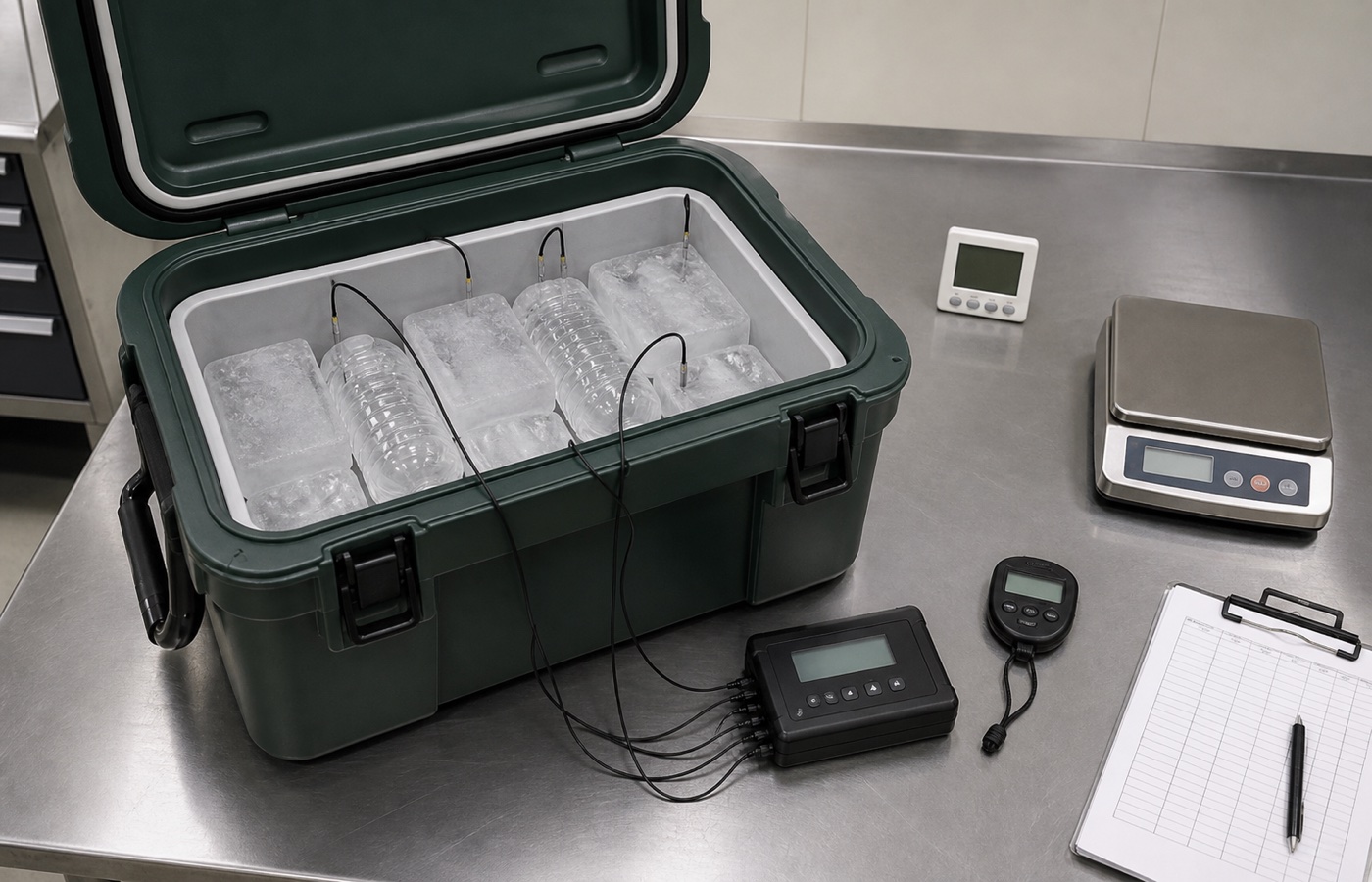
Cooler claim comparison and buyer test matrix
Use one written protocol for every shortlisted sample. Choose the ambient profile from the intended market and route instead of copying a universal temperature.
| Test field | Required supplier entry | Why it changes the result |
|---|---|---|
| Exact sample | Model, mould revision, materials, insulation and net weight | Prevents a tested sample being replaced by a cheaper production version |
| Preconditioning | Starting temperature of box, ice/coolant and payload | A pre-chilled empty box can overstate real-use performance |
| Ambient profile | Temperature and humidity over time | Indoor 25°C and a hot delivery route are not equivalent |
| Payload | Product type, mass/volume and starting temperature | Warm beverages or food consume cooling capacity |
| Ice/coolant ratio | Mass and arrangement of ice or packs versus payload | “Full of ice” leaves less saleable payload |
| Opening cycle | Number, duration and timing of lid openings | Retail and delivery use introduces hot air repeatedly |
| Sensors | Location, logging interval and calibration record | One sensor can miss the warmest area or a poor lid seal |
| Endpoint | Agreed internal temperature or ice-loss criterion | “Some ice remains” and “payload stays below target” answer different questions |
| Repeats | Number of samples and runs; pass/fail tolerance | One favourable sample does not show production consistency |
| Report | Time-stamped data, photos, sample ID and exceptions | Allows the buyer to trace the result to the ordered model |
A factory demonstration can screen samples, but it should not be presented as an independent laboratory certificate. If the intended use is food, pharmaceuticals or another controlled cold chain, the importer must separately confirm destination requirements and the applicable validation route.
Compare usable payload and container economics
A large catalogue capacity can hide thick walls, a tapered interior, wheel wells or a bulky lid. A useful specification separates external dimensions, internal top and bottom dimensions, empty weight and the capacity basis. For example, YETI’s current size guide publishes both internal and external dimensions and states can capacity at a 2:1 ice-to-can ratio. That is a disclosure benchmark, not a recommendation to copy its construction or performance (YETI hard-cooler size guide).
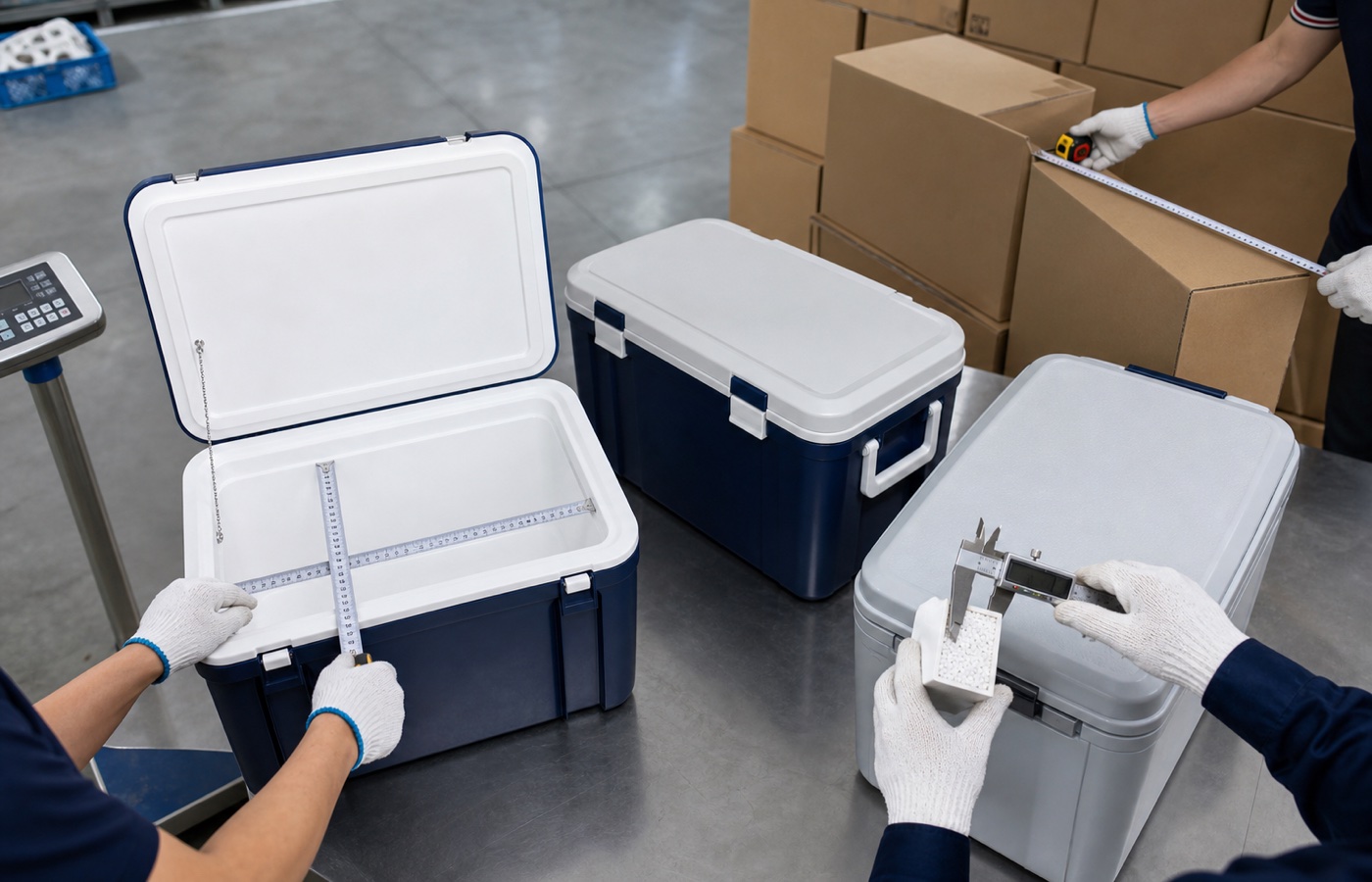
Ask each China supplier for:
- verified internal dimensions at the narrowest usable points;
- payload capacity at the agreed ice/coolant ratio;
- net and gross unit weight;
- individual carton dimensions and gross weight;
- pallet or floor-loading plan;
- verified units per 20GP, 40GP and 40HQ;
- whether boxes can nest without damaging gaskets or surfaces;
- spare-parts cartons and their added cube.
Two calculations expose a misleading low quote:
Landed cost per usable litre = landed unit cost ÷ verified saleable-payload litres
Container margin before overhead = sellable units × expected unit margin − sample, inspection, spare-parts, damage, finance and freight allowances
Customs duties and taxes must be calculated for the exact destination and product classification. Do not reuse one country’s landed-cost assumption across West, North and Southern Africa.
Inspect the parts that create returns
Rotomoulded, injection-moulded and blow-moulded boxes can each serve a price tier; the manufacturing process alone does not prove quality. The buyer should verify wall and insulation consistency, lid alignment, gasket compression, latch force, hinge-pin retention, handle anchors, drain leakage, wheel attachment where fitted, colour consistency and odour.
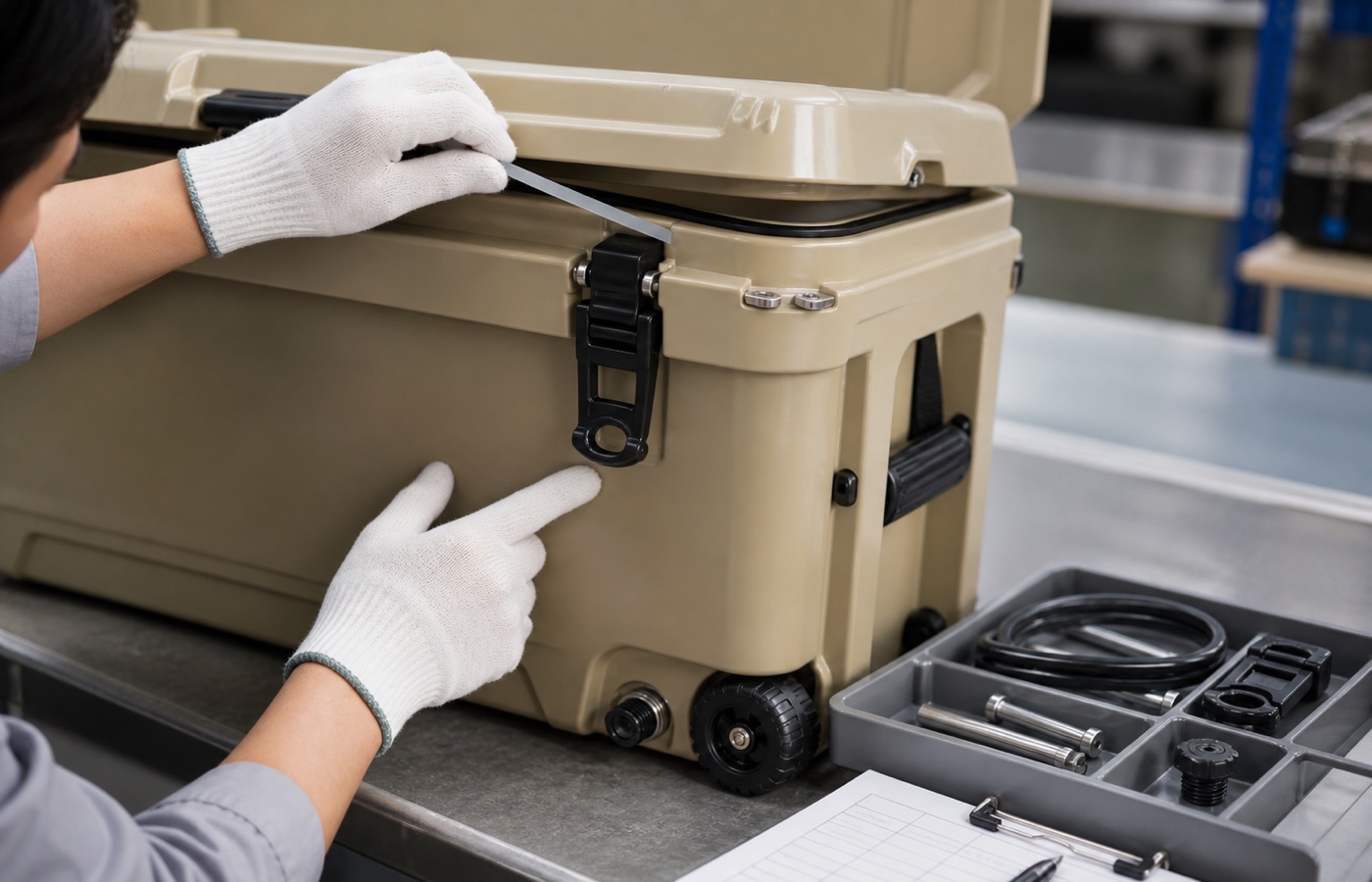
Before the deposit becomes non-refundable, require a sealed golden sample and an approved specification sheet. Before shipment, compare production units with that sample, weigh a sample across cartons, repeat the agreed thermal screen, operate latches and hinges repeatedly, leak-test drains, inspect carton protection and confirm spare gaskets, latches, hinges and drain plugs. The purchase order should prohibit unapproved material, mould or component substitution.
RFQ handoff for a China sourcing plan
Send DDNZ the supplier quotations, model links, target countries, expected resale tier, order quantity, payload, required cooling duration and destination port. DDNZ can organise a comparable RFQ, supplier-document review, sample test plan, inspection scope, container-loading check and China export coordination.
Request an outdoor-products sourcing plan
Sources
- ASTM D3103-20(2025): Thermal Insulation Performance of Distribution Packages
- WHO E004: Cold Boxes and Vaccine Carriers
- YETI Hard-Cooler Size Guide
- Boright 33QT Rotomoulded Cooler
- Cool Ride Product Brochure
- Polymer 16QT Cooler Product Page
- YETI First-Quarter 2026 Results
- LUKS Group: Sub-Saharan Africa Distribution Announcement
Research checked on 14 August 2026. Supplier claims require exact-model human review and sample verification before commercial use.