
The short answer: Climate Class 5 is a useful filter for a commercial refrigerator intended for a hot Gulf kitchen, but it is not enough to approve a purchase order. A Class 5 declaration normally identifies a defined test condition; it does not by itself prove performance in a hotter condenser inlet, a more humid site, poor ventilation or the exact operating pattern of your kitchen. Before comparing prices, bind every performance claim to the exact model number, matching technical documents, stated installation limits and the destination market's current conformity route.
Three decisions to make before supplier comparison
- Match the standard to the cabinet. A retail display cabinet, professional storage cabinet, beverage cooler and household refrigerator can fall under different test standards and regulatory scopes.
- Match the claim to the exact SKU. Ask for the model data sheet, installation manual, nameplate artwork and test or declaration reference for the unit you will actually buy.
- Match the cabinet to the site. Confirm ambient temperature and humidity at the condenser inlet, ventilation, heat sources, power supply, usage pattern and service capability before releasing the order.
What Climate Class 5 actually tells you
For professional refrigerated storage cabinets, the EU technical reference defines test-room Climate Class 5 as 40°C dry-bulb temperature and 40% relative humidity. The same regulation describes a heavy-duty cabinet as one capable of maintaining chilled or frozen operating temperature under those Class 5 ambient conditions. These figures are a clear comparison point, but they remain stated test conditions—not a universal promise for every Gulf kitchen. European Commission, Regulation 2015/1094
Do not convert “Class 5” into “works anywhere up to 50°C,” “suitable outdoors” or “approved for the UAE” unless separate evidence supports that statement. The test-room air condition, cabinet load, door-opening pattern, ventilation and required internal temperature all affect whether two claims are genuinely comparable.
First identify the cabinet type and intended use
A standard number can sound authoritative while still being wrong for the product. ISO 23953-2:2023 covers refrigerated display cabinets used for the sale and display of food. Its published scope expressly excludes cabinets intended for storage and cabinets used in catering or other non-retail applications. A restaurant storage refrigerator should therefore not be accepted against ISO 23953 merely because a supplier places that number in a catalogue. ISO 23953-2:2023 scope
Write the intended use into the RFQ: chilled or frozen storage, display or back-of-house use, food type, pull-down requirement, operating temperature, door or drawer configuration and whether the unit sits below cooking equipment. Then ask the supplier to identify the applicable performance and safety standards for that exact configuration.
The high-ambient evidence matrix
Use this table as a release gate. “Supplier says tropicalized” is not an accepted document.
| RFQ field | Evidence to accept | Stop or clarify when |
|---|---|---|
| Exact identity | Manufacturer, model/SKU, revision and intended use match across quotation, manual, data sheet and nameplate | The report or manual covers only a brand, series or different suffix |
| Climate declaration | Climate class plus dry-bulb temperature, relative humidity and cited test method | Only “tropical,” “Gulf model” or a maximum temperature appears |
| Temperature duty | Declared chilled/frozen range, test load and any pull-down or loading limits | A no-load showroom reading is used as performance evidence |
| Installation | Manual states airflow, clearances, heat-source restrictions, indoor/outdoor scope and commissioning steps | The supplier cannot provide the installation manual before shipment |
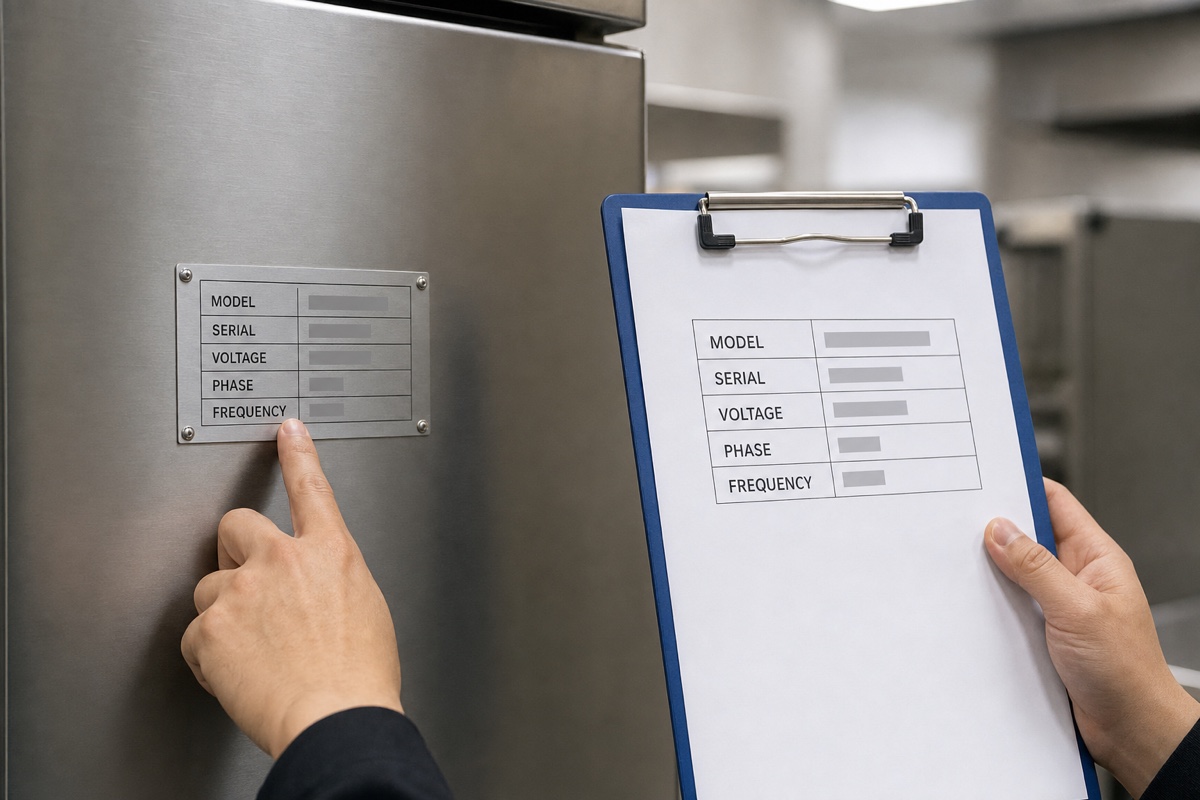
| Electrical | Voltage, phase, frequency, plug, rated input and circuit requirements match the destination | The quotation and data plate artwork conflict |
| Refrigerant and service | Refrigerant type/charge, service documentation and destination spare-parts plan are disclosed | The local technician cannot legally or practically service the configuration |
| Market conformity | Importer confirms classification, current technical regulation, test report and certificate route for the exact model | A household, EU or other-market document is presented as automatic Gulf approval |
Why model-level documents matter
Manufacturer records show why a family-level claim is unsafe. A current True TRCB manual states Climate Class 5 at 40°C and 40% RH, then separately requires adequate airflow, specified clearances, a matching data-plate supply and a dedicated circuit. The performance declaration and installation conditions must be read together. True TRCB installation manual
A Williams Amber technical sheet assigns Class 4 to some models and Class 5 to others within the range. That difference can be hidden when a seller describes the entire catalogue as heavy duty. Williams Amber technical data
Hoshizaki's 2026 sheet for SKU WHE81110001 ties its Class 5 statement to an exact model and a stated ambient limit of 40°C while also listing refrigerant, capacity and construction details. It is useful model evidence, but it still does not establish the conformity route or suitability of a different SKU. Hoshizaki exact-model data sheet
Record the Gulf kitchen conditions before ordering
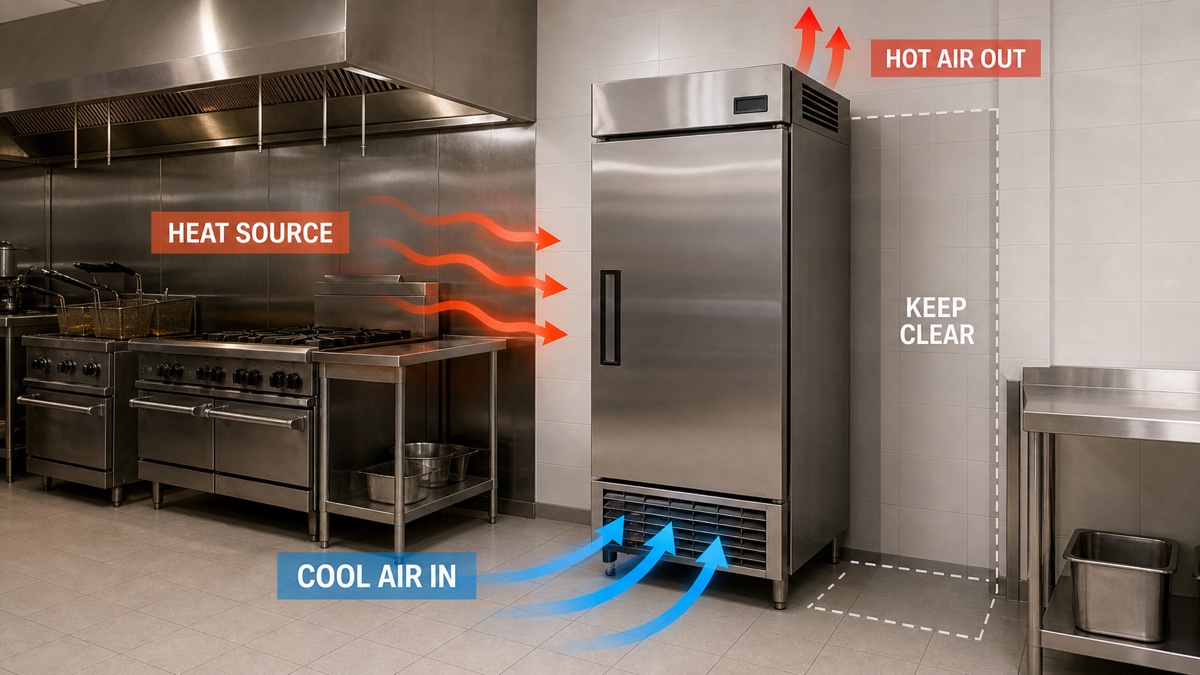
The relevant ambient is the air the condenser actually receives, not the city's weather forecast. Record the proposed location during a busy period: ventilation status, nearby fryers or ranges, exhaust discharge, direct sunlight, ceiling or wall restrictions and whether several condensing units reject heat into the same room.
Also define the operating duty. A storage cabinet holding pre-chilled food is not the same task as repeatedly loading warm product. Door openings, product spacing, overloading and cleaning practices can change cabinet recovery. Ask the kitchen consultant or refrigeration engineer to define the required duty where food-safety or project specifications are involved.
Electrical details need the same discipline. Put voltage, phase and frequency into the purchase order and approve the nameplate artwork before production. Do not assume that a model offered in China has the destination-market electrical configuration merely because the cabinet dimensions and appearance are identical.
Keep climate performance separate from conformity
Climate-class evidence describes performance conditions; destination conformity is a separate question. In the UAE, Cabinet Resolution No. 1 of 2024 names UAE.S 5010:2024 Part 3 for household refrigerating appliances. That wording should not be used to automatically include or exclude a professional kitchen cabinet. UAE Cabinet Resolution No. 1 of 2024
The UAE Ministry of Industry and Advanced Technology explains that its conformity-certificate service applies to products subject to technical regulations and requires an accredited-laboratory test report. Its product-conformity data also contains a commercial refrigerating-appliances category. The practical rule is to have the UAE importer or conformity specialist check the exact product classification and current document route before shipment—not after the cargo arrives. UAE MoIAT conformity service
For Saudi Arabia or another GCC destination, repeat that scope check with the responsible importer and current national platform or authority. Do not reuse a UAE conclusion without confirmation.
What to request before a sourcing quotation
Send the destination country, application, cabinet list, required temperature duty, site ambient information, electrical supply, dimensions, door/drawer layout and expected quantities. Request these six files for every shortlisted model:
- exact-model technical data sheet;
- installation and operation manual;
- nameplate and label artwork;
- cited test report or declaration;
- refrigerant and service-parts information;
- packing dimensions, weight and handling instructions.
DDNZ can organize supplier comparison, document-gap review, pre-shipment inspection criteria, consolidation and export planning from China. Final conformity and site design should be confirmed by the destination importer and qualified local professionals.
Sources
- European Commission — professional refrigerated storage cabinet climate classes
- ISO — ISO 23953-2:2023 published scope
- UAE Legislation — Cabinet Resolution No. 1 of 2024
- UAE Ministry of Industry and Advanced Technology — conformity certificate service
- True Manufacturing — TRCB installation manual
- Williams Refrigeration — Amber technical data
- Hoshizaki Europe — WHE81110001 data sheet