
Nigerian kitchen-equipment dealers do not need a factory’s full catalogue for a first order. They need a compact range that covers the most common cooking, cold-storage and food-preparation jobs, works with local utilities, and can be serviced with parts that are available after delivery. The safest first-container strategy is therefore to select by equipment role, not by the number of models: lock the voltage, phase, gas configuration, refrigeration duty and spare-parts pack first, then compare model-specific quotations. This guide gives dealers a practical shortlist and the questions to settle before paying a deposit.
In brief
- Build the first range around six equipment roles, with as many shared controls and spare parts as possible.
- Treat voltage, phase, gas type and high-ambient refrigeration performance as order specifications—not details to fix after arrival.
- Use upcoming Lagos hospitality events to validate dealer enquiries before widening the range.
Start with sellable roles, not a wide catalogue
A broad catalogue can look impressive, but it also ties cash up in models that have no confirmed buyer. For a new dealer range, the better question is: which daily kitchen jobs appear repeatedly in restaurant, hotel, bakery, catering and institutional projects?
That usually produces a much shorter list: core cooking, frying, chilled storage, frozen storage, meat preparation and mixing. Each role can begin with one carefully specified core model and, only where enquiries justify it, a second price or capacity tier.
The table below is a shortlisting template, not a forecast of Nigerian sales. Dealers should test it against their own customer enquiries before confirming quantities.
| Range role | Practical starting type | Fields that must be locked | Useful service kit |
|---|---|---|---|
| Core cooking | Four-burner gas range with oven | LPG or natural gas; nozzle and pressure; flame-failure protection; burner input; oven thermostat | Thermocouples, igniters, knobs, nozzles and door seals |
| Frying | Single- or twin-tank gas fryer | Tank capacity; independent controls; gas type; drain design; thermostat and high-limit protection | Thermostat, high-limit device, thermocouple and drain seals |
| Chilled storage | Upright commercial chiller | Declared test/climate condition; operating temperature; refrigerant charge; 230 V/50 Hz; condenser access | Controller, probe, fan motor and door gasket |
| Frozen storage | Upright commercial freezer | Ambient rating; pull-down and recovery performance; refrigerant; voltage and phase | Controller, probe, fan motor and gasket |
| Meat preparation | No. 12 or No. 22 meat grinder | 230 V single-phase or 400 V three-phase; plate sizes; motor duty; verified throughput | Knife, plates, seals and switch |
| Bakery and mixing | 20–30 L planetary or spiral mixer | Input load; dough/flour range; speed settings; motor duty; voltage and phase | Belts or gears, switches and seals |
Utilities can decide whether the equipment is saleable
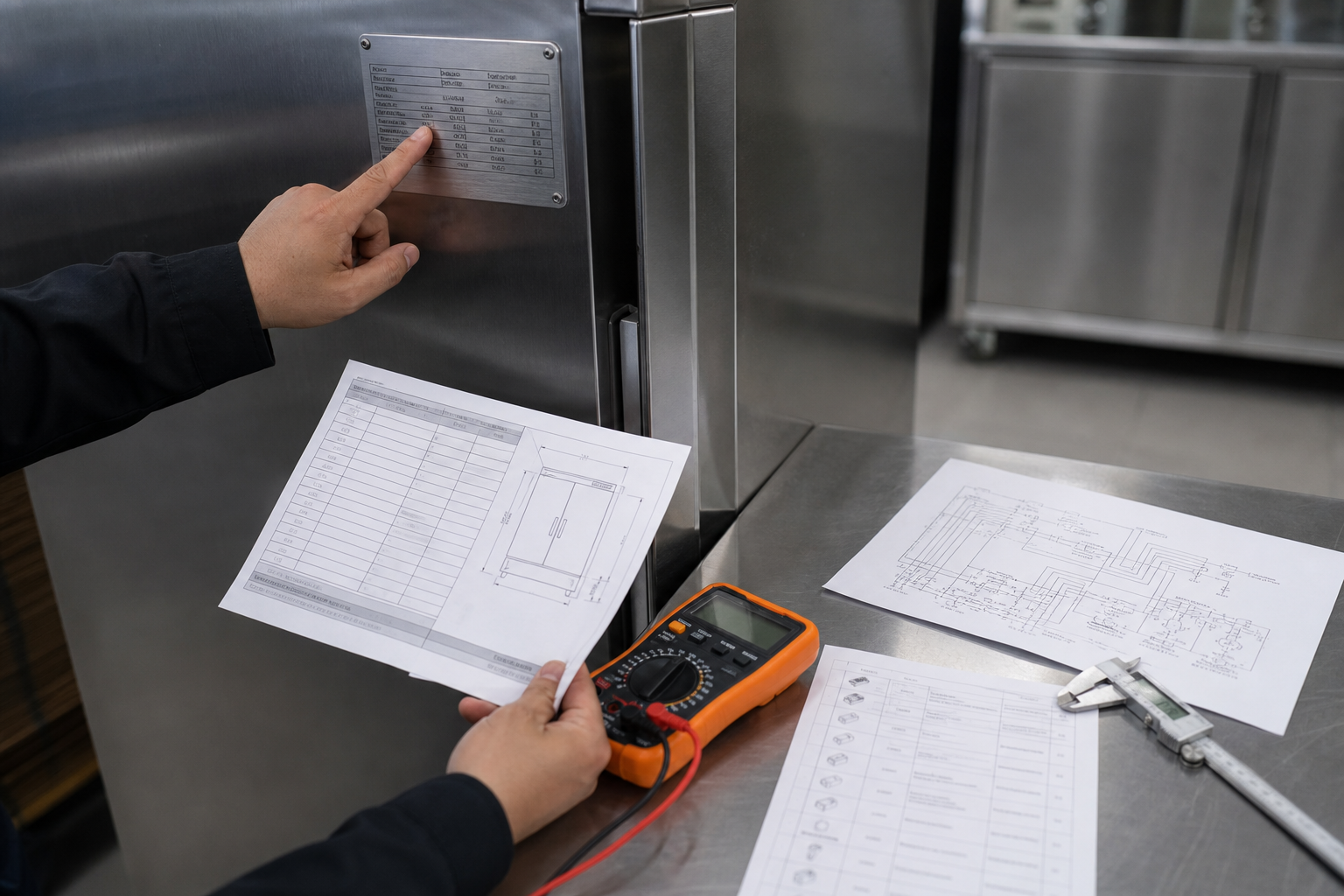
Nigeria’s nominal low-voltage supply is 230 V line-to-neutral and 400 V line-to-line at 50 Hz, according to the Nigerian Electricity Management Services Agency. That does not mean every Chinese “220 V” model can be ordered without checking the nameplate, wiring diagram, plug or isolator requirement.
The difference is especially important in food-preparation equipment. Current Chinese supplier catalogues show smaller meat grinders offered at 220 V/50 Hz, while larger models may move to 380 V three-phase. A dealer should therefore request the exact electrical declaration for the quoted model and match it to the intended installation—not rely on a family brochure.
Gas appliances need the same discipline. “Gas fryer” is incomplete as an order description. The purchase order should state LPG or natural gas, target pressure, nozzle configuration and required flame-failure protection. Ask the factory to photograph the gas label and installed nozzle before packing.
Refrigeration needs a model-specific performance check
A cabinet that reaches temperature in a mild showroom may behave differently beside fryers and ranges in a hot kitchen. Supplier pages currently show large differences in declared cabinet configuration, temperature range, refrigerant and electrical load. Some also declare an N climate class, which should not be assumed suitable for every high-ambient installation.
For professional refrigerated cabinets, ISO 22041:2019 provides a current international framework for performance and energy testing, while IEC 60335-2-89:2019 covers safety for commercial refrigerating appliances. Dealers do not need to turn every quotation into a standards lecture. They do need to ask:
- Under what ambient temperature and humidity was the model tested?
- What cabinet temperature range was maintained?
- What refrigerant and charge are on the nameplate?
- Can the condenser be cleaned without dismantling the cabinet?
- Are the controller, probe, fan motor and gasket available as spare parts?
Nigeria’s Standards Organisation also operates a mandatory energy-labelling scheme for products within its scope. Before quoting a refrigerator or freezer, the importer should confirm whether the exact cabinet is covered and what testing or technical documentation is required. Do not assume that all commercial cabinets are either included or exempt.
Turn the shortlist into a controlled trial order
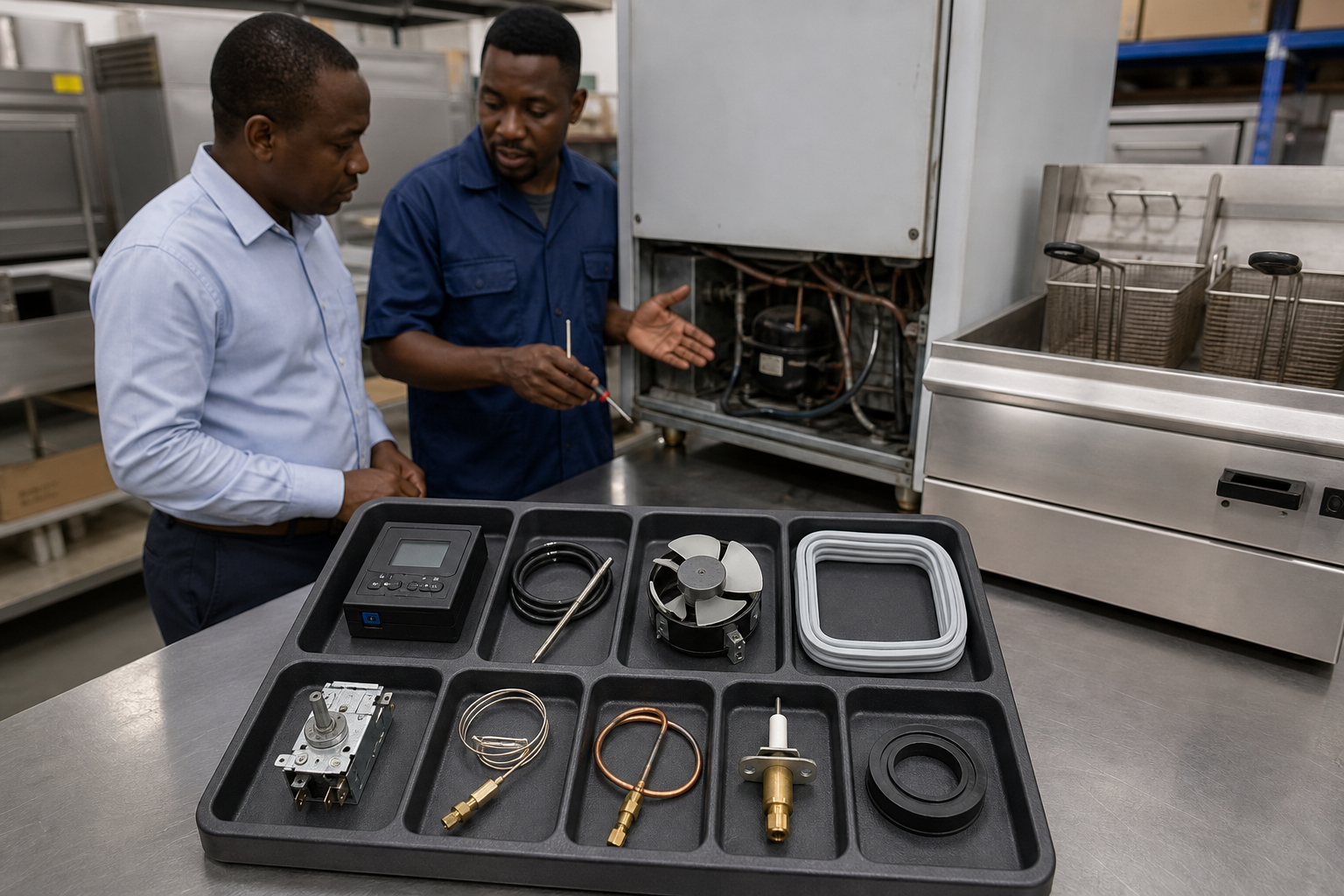
The first order should create information as well as inventory. For every shortlisted model, request a small “model dossier” containing the final quotation, specification sheet, nameplate artwork, wiring or gas diagram, exploded-parts list, packing dimensions and gross weight.
Then compare the range as a system:
- Do several appliances share thermostats, controllers, fan motors or switches?
- Can the supplier pack a labelled spare-parts kit by model?
- Are service-access panels reachable after installation?
- Do carton and crate dimensions match the loading plan?
- Are model numbers identical across the quotation, nameplate, manual and packing list?
- Is any proposed substitute subject to written approval before production?
These controls are more useful than chasing the lowest unit price. A cheaper model can become expensive if the dealer cannot install it, source a controller, or explain a specification change to a project customer.
Use the 2026 Lagos events to validate the range
The Africa HORECA Expo – Nigeria & Western Africa is scheduled in Lagos for 15–17 September 2026. Hotel Expo Nigeria lists a Lagos event for 28–29 September 2026. These events are useful as B2B interview opportunities, but their existence is not proof that every model will sell.
Before widening the order, dealers can show the six-role matrix to real restaurant operators, hotel project teams, installers and sub-dealers. Record which capacities, fuels, voltages, price bands and spare-parts questions recur. The result should decide the second order—not a factory’s catalogue ranking.
Africa’s hotel-development pipeline is active: W Hospitality Group’s 2026 report tracks 675 hotel and resort projects with 123,846 rooms across the continent. That signals project activity, not guaranteed equipment demand. Dealers still need local enquiry evidence and project-specific bills of quantities.
What to confirm before paying a deposit
A quotation is ready for approval only when it identifies the exact model and configuration. Before payment, confirm:
- Model number and time-stamped nameplate artwork.
- Voltage, frequency, phase, rated input and plug/isolator arrangement.
- LPG or natural-gas configuration, pressure and safety device.
- Refrigeration test condition, temperature range, refrigerant and service access.
- Included accessories and an itemised spare-parts kit.
- Packing dimensions, gross weight and crate method for each model.
- Production milestones, inspection point and written substitution rule.
- Manuals, diagrams and technical documents required by the Nigerian importer.
A reliable first range is not the one with the most SKUs. It is the range a dealer can quote clearly, install correctly and support after the sale.
Planning a first mixed order? DDNZ can compare Chinese suppliers, verify model documents, coordinate inspection, consolidate equipment and prepare the export shipment. Request a commercial-kitchen sourcing plan.
Sources
- NEMSA — Nigerian Electricity Supply and Installation Standards Regulations
- Standards Organisation of Nigeria — Mandatory Energy Labelling Scheme Guideline, Version 1.1 (2026)
- ISO 22041:2019 — Professional refrigerated storage cabinets and counters
- IEC 60335-2-89:2019 — Safety requirements for commercial refrigerating appliances
- Africa HORECA Expo — Nigeria & Western Africa 2026
- W Hospitality Group — 2026 Africa Hotel Chain Development Pipeline
Last verified: 26 August 2026. Supplier-declared specifications must be rechecked against the exact model ordered.