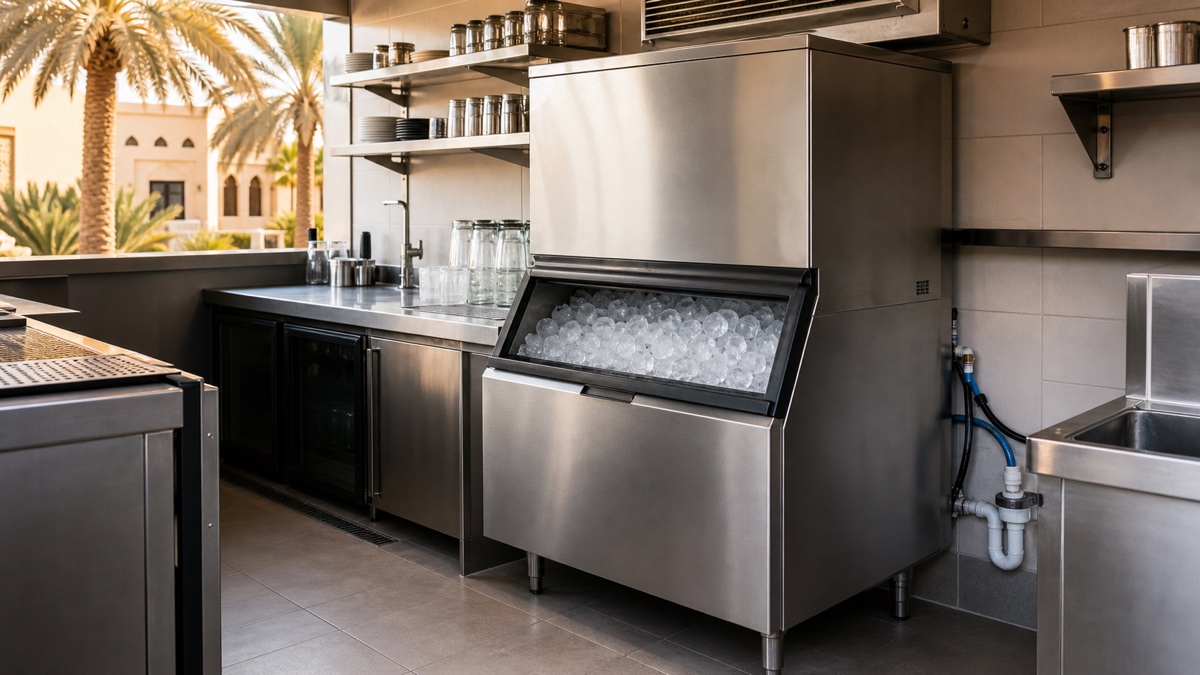
Three points to know
- Daily output is conditional. Air temperature and incoming water temperature must sit next to every kg/day figure.
- Peak production and stored ice are different. Machine harvest rate, bin capacity and the service peak must be checked separately.
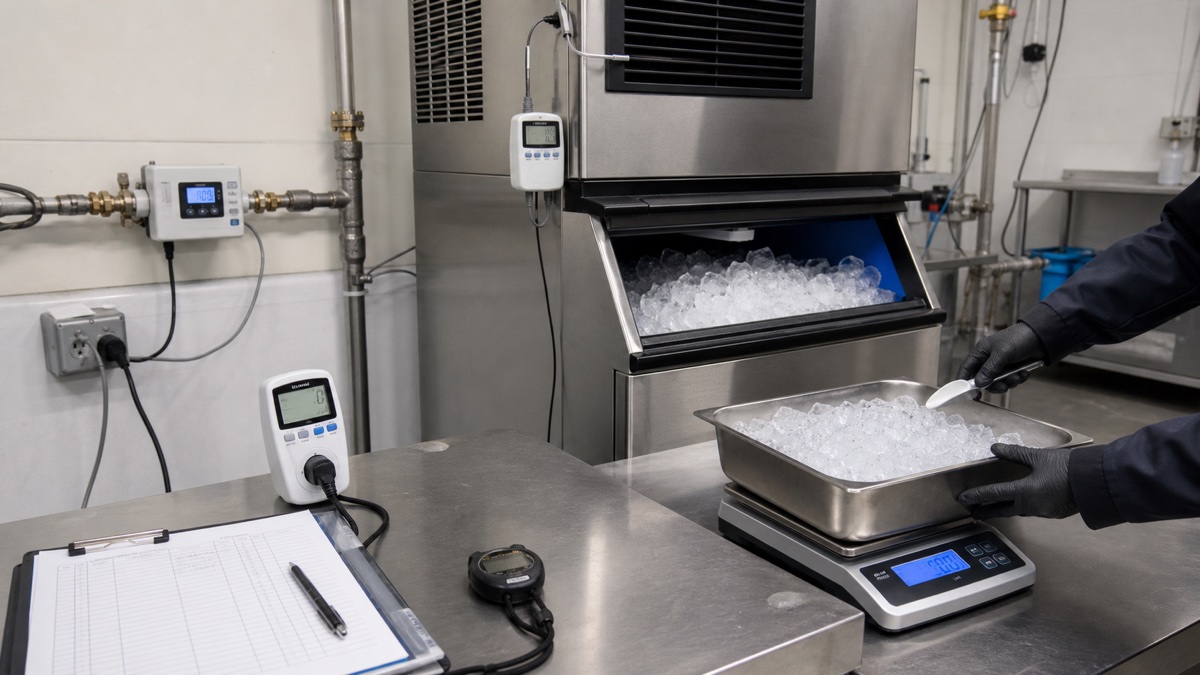
- A useful factory test records conditions. Measure ice mass, time, air temperature, water temperature, power and water; a video of cubes falling is not evidence of 24-hour capacity.
Start with a comparable rating
ANSI/AHRI 810-2025 covers definitions, testing, ratings, minimum published data and nameplate information for automatic commercial ice makers. It gives buyers a useful principle even when a Chinese supplier is not AHRI-certified: a performance number is comparable only when the test method and rating conditions are disclosed.
A Hoshizaki Singapore IM-series sheet publishes output at both 21°C air/15°C water and 32°C air/21°C water. Manitowoc’s 2026 product literature also publishes daily production at two air/water conditions. These are benchmark examples, not claims about every machine.
| Published model example | Cooler condition | Warmer condition | Observed difference |
|---|---|---|---|
| Hoshizaki IM-65LE | 47 kg/day at 21°C air, 15°C water | 39 kg/day at 32°C air, 21°C water | 8 kg/day lower, about 17% |
| Hoshizaki IM-130ME | 104 kg/day at 21°C air, 15°C water | 88 kg/day at 32°C air, 21°C water | 16 kg/day lower, about 15% |
| Manitowoc iP0300 example | 325 lb/day at 70°F air, 50°F water | 246 lb/day at 90°F air, 70°F water | 79 lb/day lower, about 24% |
| Manitowoc UP310 example | 330 lb/day at 70°F air, 50°F water | 270 lb/day at 90°F air, 70°F water | 60 lb/day lower, about 18% |
The percentages above are calculated from the cited manufacturer values. They are not a universal derating factor. A supplier should disclose data for the exact offered model and the intended 50 Hz or 60 Hz version.
Build demand from the service, not seat count alone
List where ice is consumed: beverages, display, food preparation, transport tubs and staff use. Record the busiest service window and whether a second shift must start with a full bin. Then separate three questions:
- How much ice must be available at the start of the peak?
- How much can the machine produce during operating hours under site conditions?
- How much buffer is required if water, cleaning or maintenance interrupts production?
This avoids two common errors: buying a large production head with an undersized bin, or buying a large bin that cannot recover after a peak.
The RFQ matrix buyers should use
| RFQ field | Supplier must provide | Why it changes the decision |
|---|---|---|
| Ice production | kg/24 h at two stated air/water conditions | Exposes performance loss in a hot kitchen |
| Ice form | Cube geometry, mass or pieces per cycle | Changes beverage presentation, melt and dispensing |
| Storage | Usable bin capacity and compatible bin model | Determines peak availability |
| Utilities | Voltage, phase, frequency, rated input, breaker, water pressure, inlet and drain | Prevents site incompatibility |
| Condenser | Air-cooled, water-cooled or remote; clearance and airflow direction | Changes kitchen heat, water use and installation |
| Water and cleaning | Water use, filtration guidance, cleaning access and approved chemicals | Changes operating cost and maintenance |
| Service file | Parts list, wiring diagram, controller codes and warranty process | Determines whether local repair is practical |
A factory test that can be audited
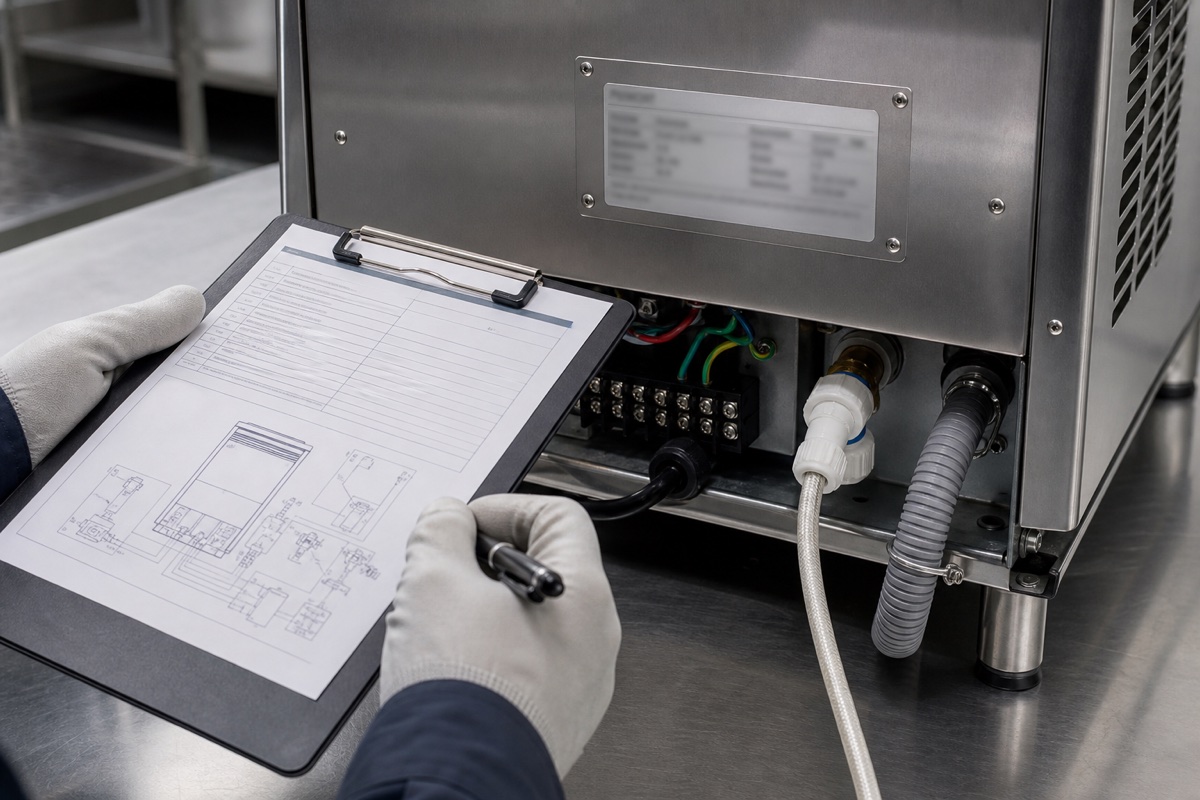
Ask the supplier to identify the offered model and serial or sample number before testing. Record ambient air and inlet-water temperature at the machine, not elsewhere in the room. After the machine stabilises, weigh harvested ice over a stated period, record cycle count, and disclose the method used to extrapolate to 24 hours. Also log electricity and water if those figures are part of the sales claim.
The test report should show the condenser clearance, filter condition, supply voltage and whether the bin thermostat stopped production. For a pre-shipment inspection, verify nameplate, plug or terminal arrangement, drain components, included filter parts, manuals, spare-parts kit and carton markings.
Buying decision
Shortlist only models that answer the same RFQ matrix. If one supplier gives a high output without air/water conditions and another gives a lower but auditable table, the second quotation is more decision-ready. Price should be compared after the machine, bin, filter, drain parts, spare parts, packaging and destination electrical version are aligned.
Need comparable quotations from Chinese commercial-kitchen suppliers? Send the site utilities, target ice type and peak-use profile: Request commercial kitchen sourcing support
Sources and verification
Last verified: 5 August 2026.
- AHRI — ANSI/AHRI 810-2025 performance rating standard
- Hoshizaki Singapore — IM-series specification sheet
- Manitowoc Ice — 2026 product and performance literature
Editorial note: manufacturer figures are shown as disclosed examples. No DDNZ test result, supplier endorsement or guaranteed site output is claimed.