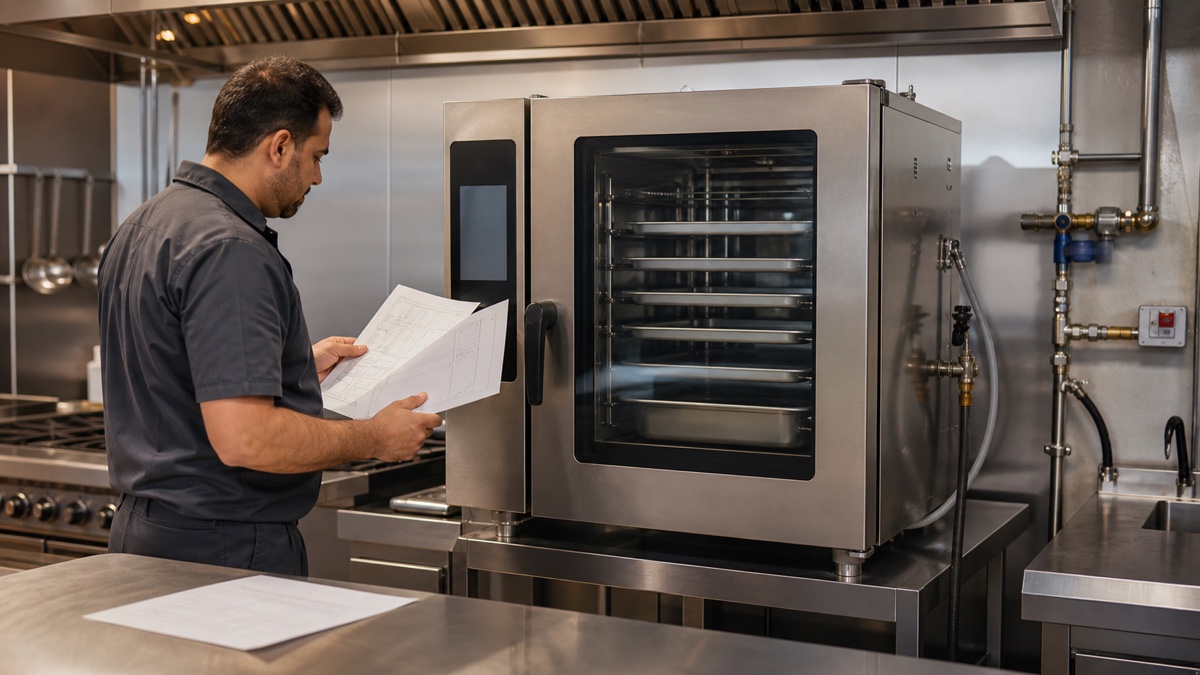
If you are sourcing a commercial combi oven from China for a restaurant, hotel or cloud kitchen in the Gulf, do not release the order on tray count, touch-screen features or a low quotation alone. Release it only after the exact model code matches the quotation, data plate and technical documents; the project team has approved power, water, drain, ventilation and clearances; and the supplier has demonstrated the buyer's real menu at a defined load. Current Gulf foodservice signals favour flexible, efficient and high-output equipment, but those benefits exist only when the selected model fits the site and the service operation.
In brief
- Buy a verified model, not a product description. Freeze the model code, voltage, phase, frequency, maximum input and utility drawings before the deposit or production release.
- Compare operating evidence, not one headline number. Peak connected load, idle energy, cooking efficiency, water use and menu throughput answer different questions.
- Make acceptance measurable. Use a model-release matrix and a witnessed menu test before final payment and shipment.
Why tray count is not real restaurant output
A 10 GN 1/1 oven tells you what fits inside the cabinet; it does not prove how many saleable portions the kitchen can produce during its busiest 30 minutes. Output also depends on the menu, pan depth, product starting temperature, loading pattern, steam demand, door openings, recovery and operator workflow.
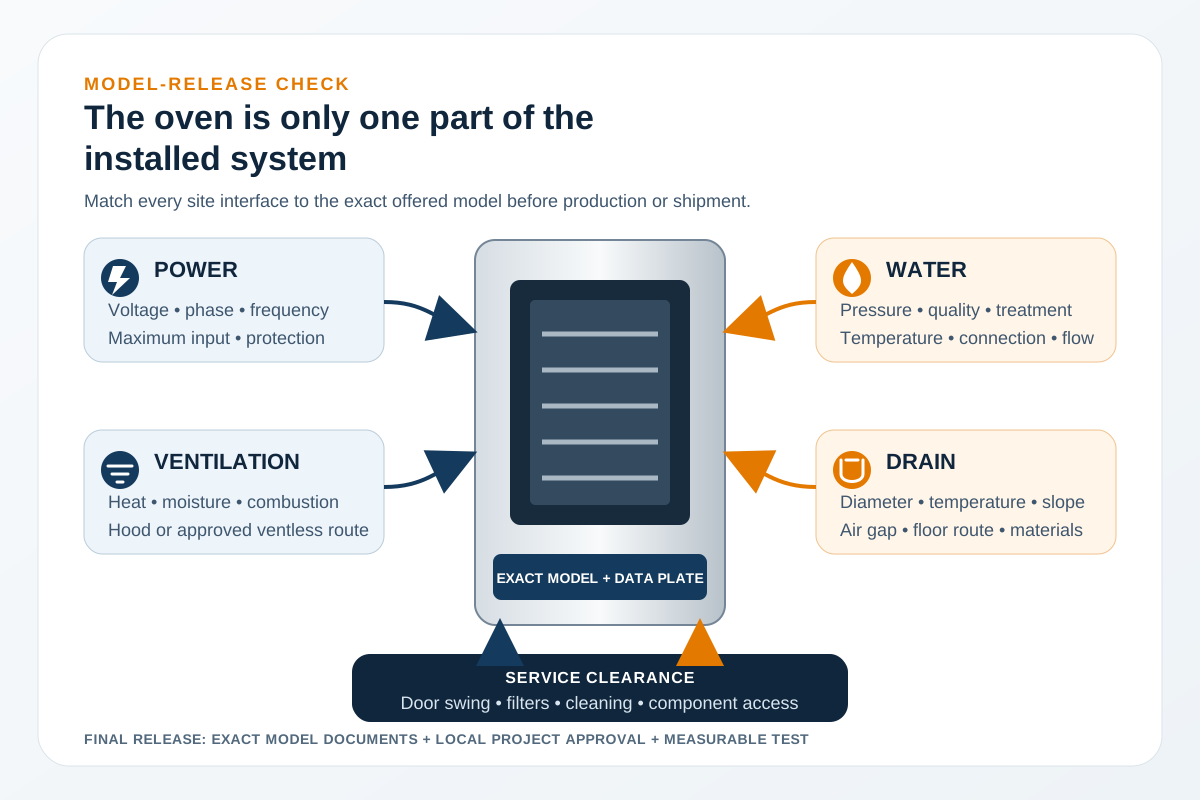
“Smart” controls can improve consistency, but they do not correct an undersized electrical service, unsuitable water, a restricted drain or poor extraction. GulfHost's current 2026 page identifies ovens, compact high-output equipment and lower energy and water consumption as regional priorities. Treat that as a buyer-interest signal—not as evidence that every connected oven will deliver those results.
The ENERGY STAR Version 3.0 criteria illustrate a better comparison method: combination ovens are assessed with separate values for idle energy, cooking-energy efficiency and water consumption. The active ASTM F2861-24 test method also measures preheat, production capacity, water and cooking performance under defined conditions. These methods support comparable claims; a buyer-menu test is still needed to confirm fit for one restaurant.
Freeze the exact model and electrical configuration
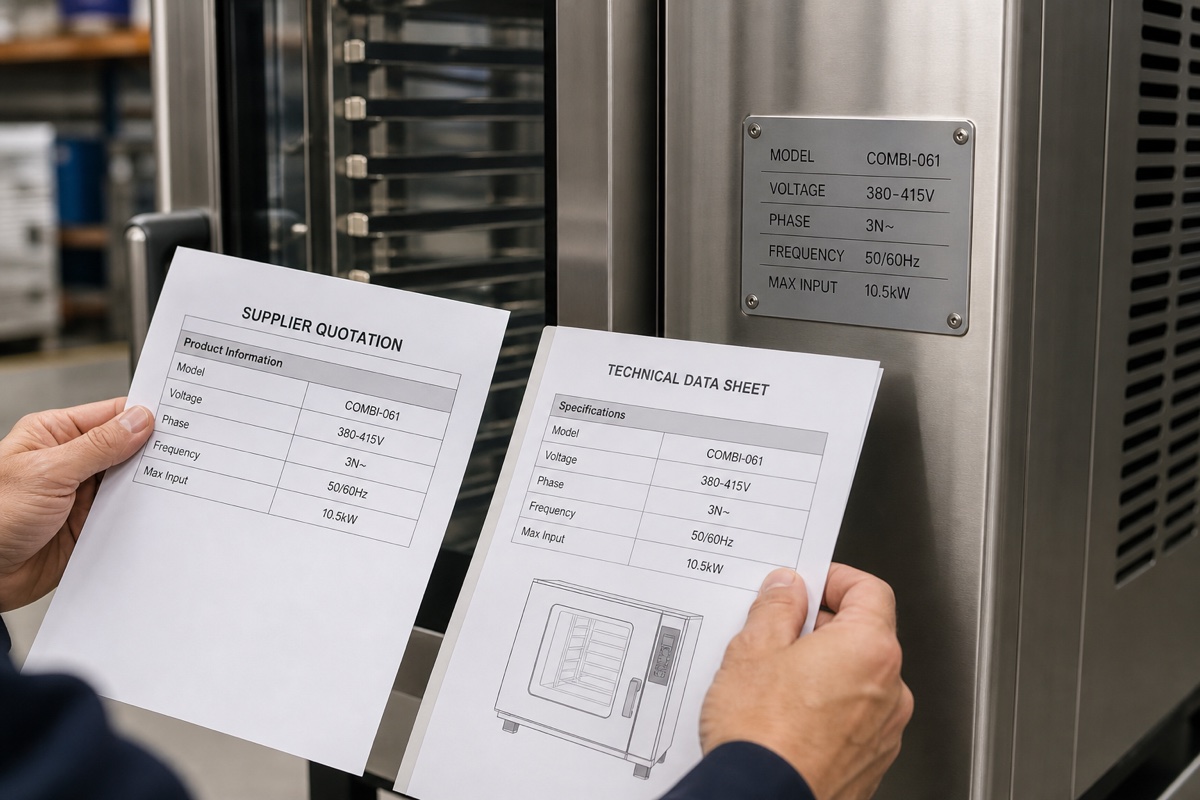
Ask the supplier to place one exact model code on the quotation, data sheet, electrical schedule, packing list and finished-unit data plate. The release pack should state voltage, phase, frequency, maximum connected load, required protective device, cable or terminal requirements, and whether any power-limiting setting changes cooking performance.
Why does this matter? A current Electrolux Professional listing for model 229747 identifies a 10 GN 1/1 electric oven, 220–240 V three-phase 50–60 Hz, with 20.3 kW maximum and 19 kW default power. Those figures apply only to that model, but they show why “10-tray electric combi oven” is not a complete specification.
For a Chinese-made model, request the same level of evidence. Do not accept a generic catalogue if the delivered nameplate, terminal layout or utility drawing will be different.
Treat water, drain and ventilation as part of the machine
Steam performance and cleaning depend on more than the presence of a water inlet. Record the required flow pressure, inlet temperature, water-quality limits, treatment recommendation, connection size, backflow arrangement and peak flow. Then confirm the drain diameter, material, temperature tolerance, slope, air gap and floor route with the project consultant or installer.
Manufacturer instructions demonstrate how specific these interfaces can be. The Electrolux model above lists 1–6 bar inlet pressure, conductivity above 50 µS/cm and a 50 mm drain. A current RATIONAL iCombi installation manual specifies a separate tap, minimum conductivity of 50 µS/cm and required flow pressure of 1.0–6.0 bar. These are examples, not universal Gulf specifications.
The actual project must also resolve hood or ventless eligibility, heat and moisture rejection, gas-model requirements and service clearances. For example, current RATIONAL instructions call for 500 mm from an electric unit's vent pipe to hood fat filters; some tabletop units may reduce this only after expert review of local conditions. The same manual specifies 350 mm from heat sources unless an applicable shield is used. These are model-family examples—not universal Gulf clearances—and a supplier statement should not replace local design approval.
Prove output with the buyer's menu
Before final model approval, give the supplier two or three peak menu items and a target service window. Define the starting product condition, recipe, pan type, portion size, number of trays and whether the load is simultaneous or staggered.
A useful witnessed test records preheat time, batch time, final core temperature where relevant, product yield, rack position, door-open recovery and alarms. Photograph the data plate and control screen in the same record. A video of a different model, partial load or unspecified food is promotional material—not acceptance evidence.
Cleaning is also model-specific. The Electrolux 229747 data sheet lists integrated descaling and four cleaning cycles, while UNOX CHEFTOP-X documentation names dedicated detergent, filtration and wash/descale processes. Price local consumables, treatment parts and safe procedures for the exact model.
If a factory cannot perform the proposed test, record the gap. The buyer can then choose a different model, arrange an independent test, reduce the promised output, or hold the risk explicitly instead of discovering it after installation.
Combi-oven model-release matrix
| Decision item | Evidence to request | Release condition |
|---|---|---|
| Exact identity | Quotation, model code, data sheet and finished-unit data plate | All four match |
| Real output | Defined full-load menu test with time, temperature and yield record | Buyer target met or shortfall accepted in writing |
| Electrical | Voltage, phase, frequency, maximum input, protection and terminal drawing | Project electrical reviewer approves the exact model |
| Water and drain | Pressure, quality, treatment, flow, inlet and drain requirements | Site supply and drainage plan confirmed |
| Ventilation | Heat, moisture, exhaust, hood or ventless documentation and clearances | Local consultant or installer approves |
| Operating efficiency | Test method, idle rate, cooking efficiency and water-consumption data | Comparable method and mode are stated |
| Cleaning | Cycle time, water, chemical type, dosage and local supply plan | Consumables and safe procedure available at destination |
| Service | Warranty workflow, diagnostics, parts list and critical spares quotation | Named support route and agreed spare package |
| Shipment | Dimensions, net/gross weight, packing, lifting points and accessory list | Inspection and packing photos match the order |
Red flags before paying the balance
Pause the order if the supplier will not provide an exact model code, sends technical documents for another version, or changes the proposed model after payment without a new review. Also pause when performance is shown only by an edited video, critical utility values exist only in chat messages, the factory will not show the finished data plate, or warranty support has no named process or spare-parts list.
A cheaper purchase can become an expensive project delay when the site needs an electrical upgrade, water treatment, a revised hood, new drainage or an unavailable component. The purpose of the release matrix is not to select the most expensive oven. It is to compare quotations on the same operational basis and expose hidden work before shipment.
A practical China-sourcing sequence
- Send the menu, peak output target, kitchen layout and destination utility information.
- Shortlist exact models—not generic capacities—and collect technical documents.
- Have the project consultant or installer review electrical, water, drain, ventilation and clearances.
- Agree the witnessed menu-test method and pass criteria.
- Inspect the finished unit, accessories, data plate and documents against the release matrix.
- Confirm packing, critical spares, warranty workflow and shipping dimensions before balance payment.
Need help turning a Gulf kitchen brief into a supplier comparison and inspection plan? Ask DDNZ for a commercial kitchen sourcing plan. DDNZ can coordinate supplier documentation and sourcing checks, while the destination project team retains responsibility for local design, installation and approvals.
Sources
- GulfHost 2026 — regional foodservice equipment priorities
- SaudiHost 2026 — foodservice buyers and product sectors
- U.S. EPA ENERGY STAR — Commercial Oven Key Product Criteria, Version 3.0
- U.S. EPA ENERGY STAR — active certified commercial oven dataset, updated 29 July 2026
- Electrolux Professional — model 229747 specifications
- RATIONAL — iCombi Pro / iCombi Classic installation manual
- ASTM International — F2861-24 active combi-oven performance test method
- Electrolux Professional — model 229747 technical data sheet
- UNOX — CHEFTOP-X / BAKERTOP-X user manual