Estimated reading time: 6 minutes
For small and medium-sized African traders, a low purchase price is not optional: one container may be divided into several batches for local distributors, who then supply wholesalers or retailers. Every layer needs margin. The practical answer, however, is not to trust the cheapest online number or to reject it automatically. It is to verify that the quote covers the same sellable configuration, that the legal seller and receiving bank account are genuine, and that the supplier can produce and deliver what was promised before money is released.
Three-point summary
- Compare like with like: match the speaker, battery, microphones, accessories, packing, branding, quantity, trade term and destination requirements.
- Verify the seller before the deposit: check the Chinese legal entity, bank beneficiary, factory relationship, product existence and sample.
- Pay against evidence: use written specifications, production milestones, inspection and matched shipping documents rather than price screenshots or urgent promises.
Why price pressure is rational
Many African trading businesses do not sell a whole container directly to end users. They import stock, split it into smaller lots and supply local distributors. Those distributors may sell again to wholesalers or retailers. The importer therefore has limited room for an expensive purchasing mistake.
This makes online prices powerful. A trader can see dozens of listings and reasonably ask a Chinese factory or agent to match the lowest number. The problem is that two pictures of similar party speakers do not prove that the offers describe the same product, packing or transaction.
A low quote can be genuine. It can also exclude the battery, wireless microphones, foam protection, private-label work, export packing, inspection or freight. In other cases observed in sourcing enquiries, the advertised configuration may be unavailable and a different product is proposed after contact. Production may also be delayed after partial payment, or communication may stop. These are risk scenarios to verify—not a claim about every online seller.
The low-price offer verification matrix
| What looks attractive | What must be equivalent | Evidence before payment |
|---|---|---|
| Lowest unit price | Cabinet, drivers, functions, battery, microphones and accessories | Signed specification sheet and approved physical sample |
| Same product photo | Exact model, materials, components, dimensions and packing | Current product video, label photos and sample test record |
| “Factory price” | Legal seller, factory relationship and production responsibility | Chinese registration record, contract entity and factory verification |
| Fast production promise | Capacity, material availability and realistic completion date | Written production plan and agreed progress evidence |
| Easy deposit request | Beneficiary matches the contracted seller or an explained approved structure | Contract, invoice, company details and bank-account verification |
| “Similar replacement” | Every commercial and technical point that affects resale | Side-by-side comparison and buyer's written approval |
| Final balance request | Production quantity, quality, packing and documents | Inspection report, packing list and document match |
Run a price-equivalence test first
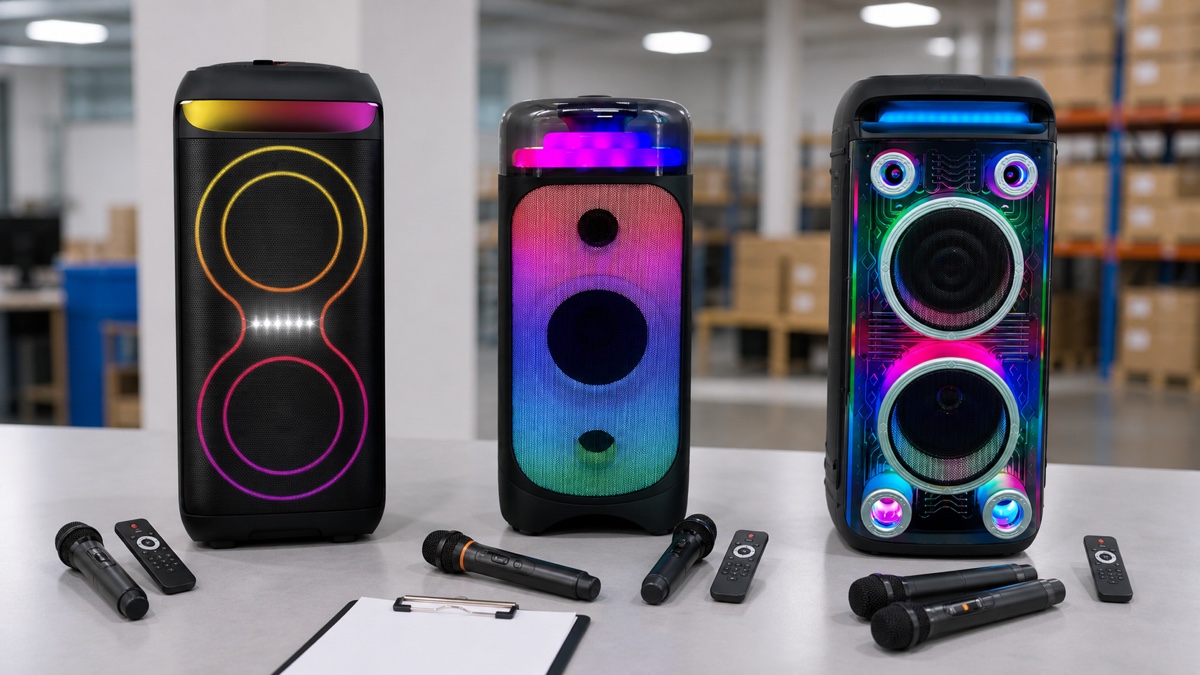
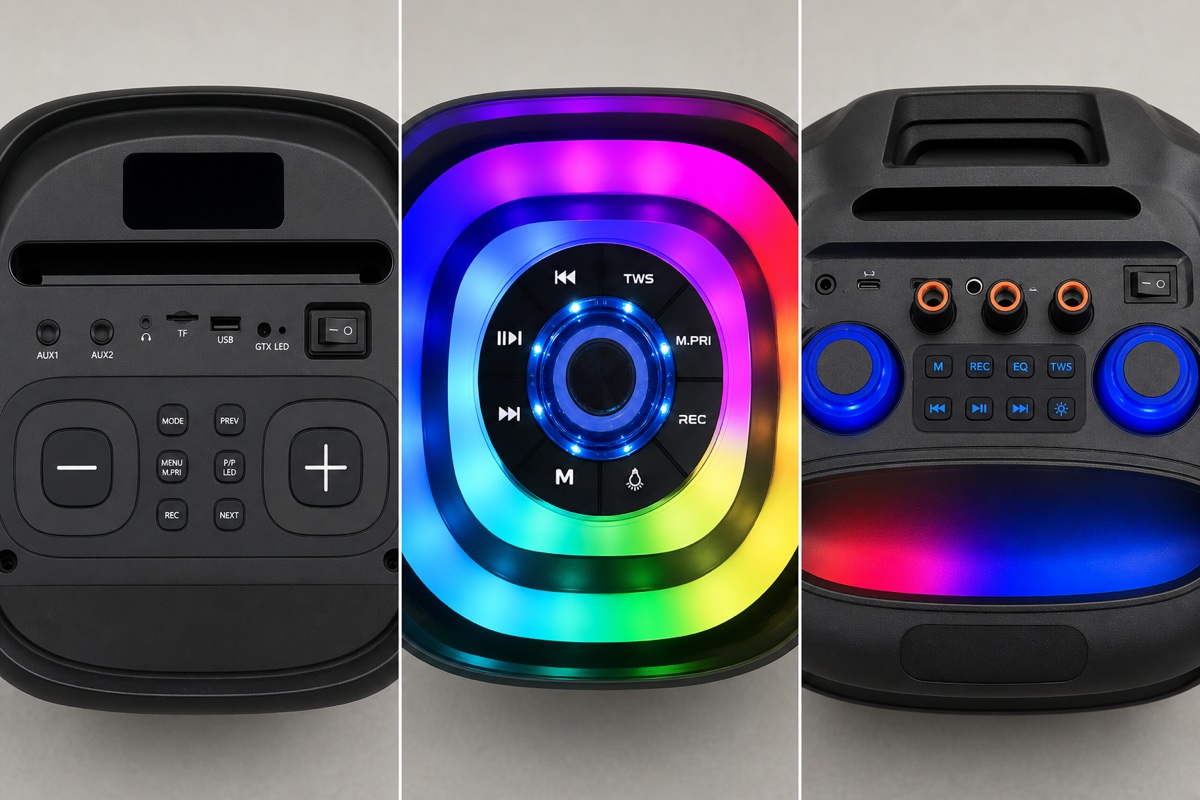
Before asking a supplier to reduce the price, put every offer into one comparison sheet. For party speakers, record the cabinet and driver configuration, key functions, exact battery model and watt-hours, wireless-microphone quantity, adapter, cables, remote control and other accessories.
Then compare the sellable presentation: carton strength, foam, manual, labels, artwork and shipping marks. Also record the minimum order, Incoterm, payment terms, production assumptions and what is excluded. A supplier offering an apparently cheaper unit may simply be quoting a different commercial package.
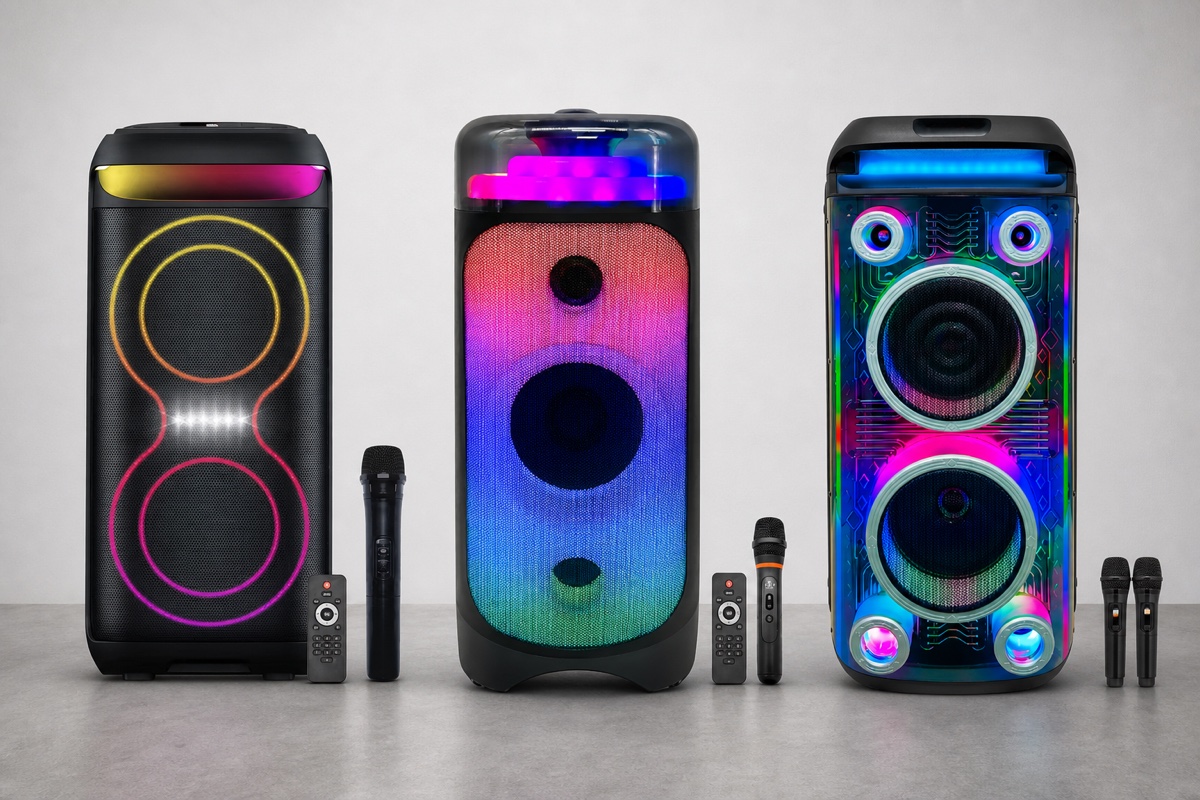
The anonymized August 2026 DDNZ quotation used for this draft contained three active-speaker configurations. All three included built-in batteries, wireless microphones, Bluetooth/TWS functions, adapters, retail packing and private-label work. That quotation is useful because it shows how many details can sit behind one price. It is not proof of a completed order, and exact model codes, customer information and prices remain private.
For a battery-powered speaker, request the exact installed battery information and a matching transport-test summary. UNECE section 38.3.5 describes the identifying information expected in a lithium-cell or battery test summary.UNECE lithium-battery test-summary requirements The purpose here is simple: a cheaper substitute battery is not equivalent merely because the voltage looks similar.
Verify the legal seller and the transaction
Search the seller's full Chinese legal name or Unified Social Credit Code in China's official National Enterprise Credit Information Publicity System. Review the registration status, establishment date, registered address and business scope, plus any available abnormal-operation or serious-illegality listing.National Enterprise Credit Information Publicity System
The quotation, contract, commercial invoice, company chop and bank beneficiary should form a coherent transaction record. If the payment beneficiary is different from the contracted seller, stop and obtain a documented explanation before paying.
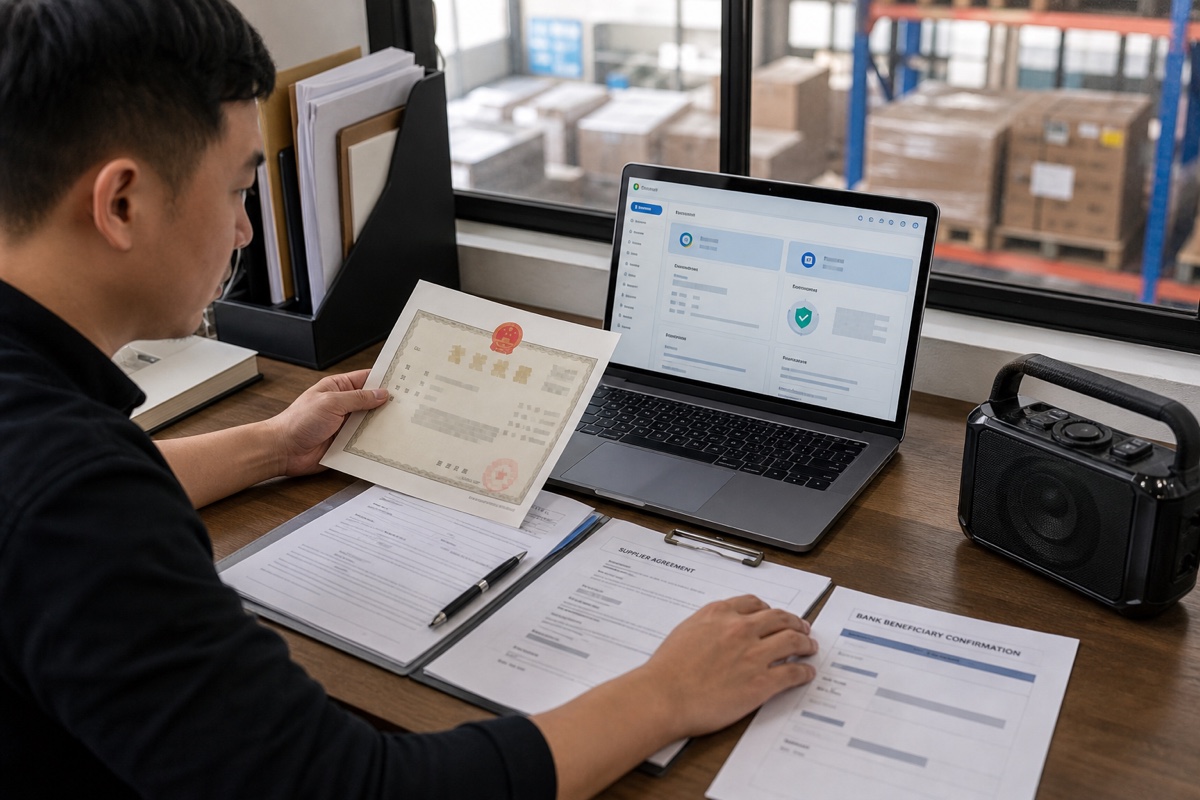
Registration alone does not prove product quality, manufacturing capacity or honest performance. A verification process should also confirm whether the seller is the factory, an authorised trading company or an unknown intermediary; whether the claimed product currently exists; and whether the supplier can show relevant production and quality-control capability. When the order value justifies it, a live video call, local visit, physical sample and independent inspection give stronger evidence than a product-page screenshot.
Make substitution impossible without approval
Use the approved sample and specification annex as the commercial definition of the product. Record the battery, microphones, functions, accessories, carton, foam, labels and artwork. State that any material or model substitution requires a written comparison and the buyer's approval before production continues.
“Similar” is not a release standard. A replacement may look acceptable online but use a different battery, driver, amplifier board, microphone, adapter or packing method. Any of these can affect reliability, freight documents, local acceptance and resale value.
Pay against evidence, not urgency
The correct payment structure depends on the contract, supplier and jurisdiction, so this guide does not prescribe a fixed deposit percentage. The control principle is consistent: release each payment only after the agreed evidence is available.
Before the deposit, verify identity, bank details, product definition and sample. During production, request agreed milestone evidence that can be checked against the order. Before final balance or shipment release, use an inspection report, final packing list, label and document comparison, and the buyer's contractual remedies where appropriate. Seek legal or banking advice when the transaction structure is unusual.
Why a South China partner changes the risk
A capable local partner cannot guarantee that every order will succeed. It can, however, verify facts that are difficult to confirm from abroad: the registered company, factory relationship, sample, production status, packing, inspection findings and handover to the freight process.
DDNZ Global Trade coordinates supplier verification and trade support alongside Heaven Born International Freight, whose China-origin freight operation dates to 1997.DDNZ Global This wording deliberately distinguishes the current trade-support brand from the history of the related freight operation; it does not claim that the present DDNZ legal entity has been continuously registered for nearly 30 years.
Sources
- DDNZ field observations, 2026 — first-party research input describing possible transaction failure modes; no frequency or market-wide incidence is claimed.
- DDNZ anonymized speaker quotation, August 2026 — first-party research input; not evidence of a completed shipment.
- National Enterprise Credit Information Publicity System — official Chinese market-entity information
- UNECE — lithium battery test-summary requirements
- DDNZ Global — company and service information
Research and drafting: DDNZ content automation. Human sourcing, company-history, quotation-confidentiality, evidence and image review completed on 10 August 2026. Published after human approval on 10 August 2026.